
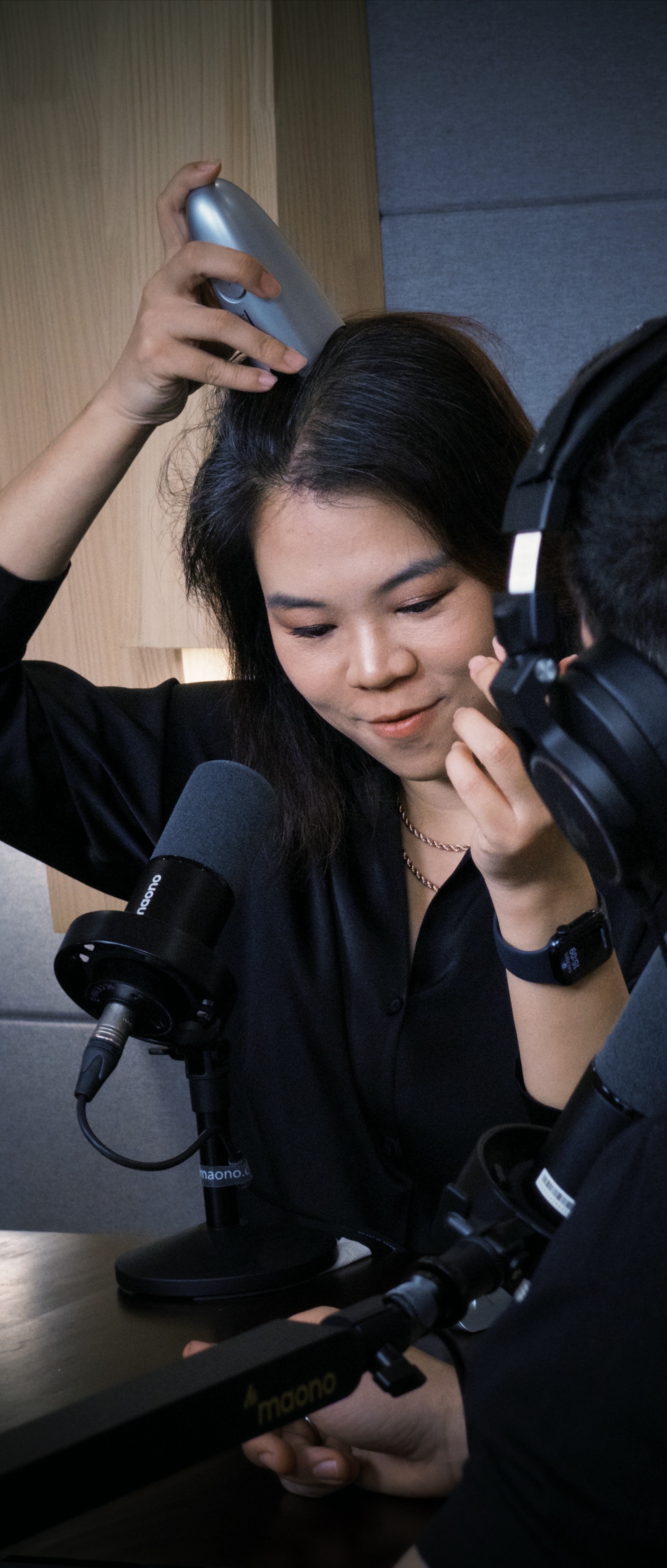
- World's first micro-misting scalp device. rootique DUO turns messy hair tonic application into a 15-second routine. Two nozzles spray nano-particles directly onto the scalp with 3.5x better absorption. The comb parts your hair so you can do it one-handed.
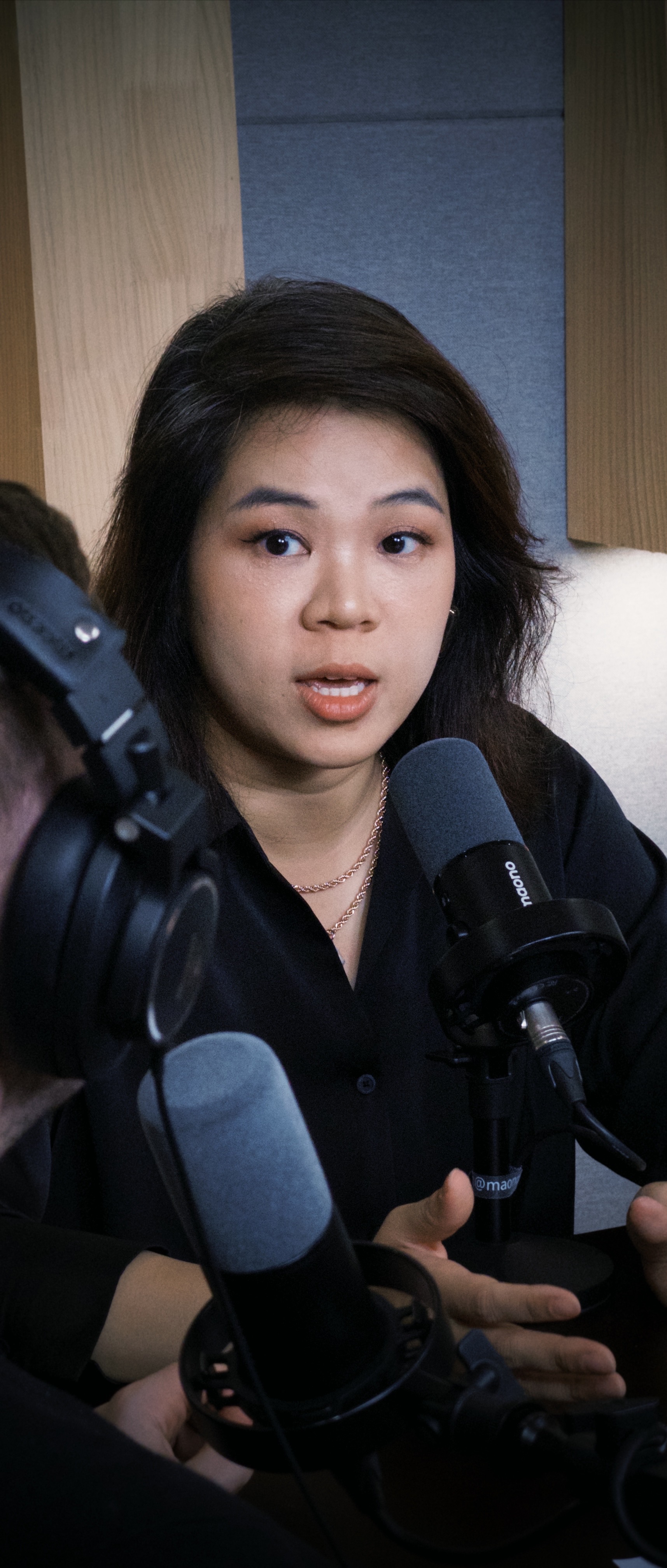
- 300,000 RMB of her own money. Denise funded the first mold herself with no investors and no co-founder. She went from marketing expert to spending every day in Shenzhen factories, learning hardware R&D from scratch.
- 90% of people quit before results. Hair treatment needs at least three months to show progress. Denise realized the real problem wasn't the formulas but the application experience. If it's messy and time-consuming, people stop.
- Factory reality check. Denise flew from New York to Shenzhen to confront her factory partner before Chinese New Year. "If you want to succeed in Shenzhen, you have to be kind of bipolar. Scream at the suppliers in the morning, be their good friends in the evening."
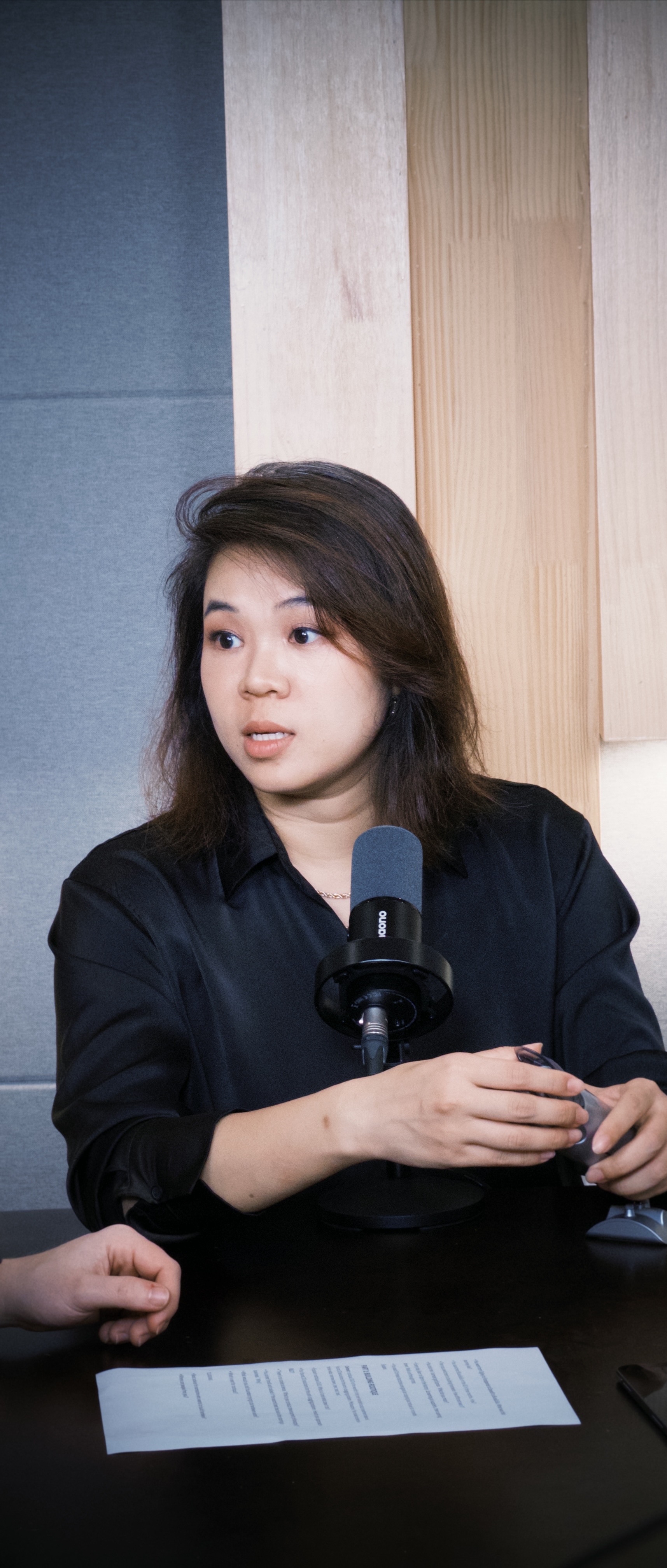
- InnoX and the Shenzhen hardware ecosystem. Denise joined InnoX in 2025, calling it her "second best decision after starting a business." The incubator connects founders with DJI, Huawei, and Anker mentors. Professor Lee, DJI's first investor, still mentors startups.
The Photo in Annecy That Changed Everything
Denise suffered from hair loss since she was 17. She tried every supplement and shampoo her mother bought her. Nothing worked. Then, during a business trip to Annecy, France, a colleague took a photo of her by the lake. Her hair was thinning, visibly sticking to her scalp. She stopped taking photos after that. That moment became the turning point. She decided that if she was going to build a company, it had to solve a problem she believed in.
From Ogilvy to Foodpanda to Hair Loss Hardware
Before rootique, Denise built an impressive corporate career. She started at Ogilvy in Hong Kong doing healthcare PR, then joined Foodpanda as the first employee in Hong Kong. She moved to bluegogo, a bike-sharing startup, and scaled their US operations in just three months. But she always knew she would start her own business. Her previous venture sold hair loss combs in the Chinese market, generating more than 10 million RMB in revenue. That experience proved the market existed, but she realized the products were inadequate.
15 Seconds, No Mess, 3.5x Absorption
The idea came from head spas. Denise went every week and noticed how they sprayed tonics directly onto the scalp using large professional devices. She thought: what if I could shrink that into something people use at home, one-handed, in 15 seconds?
The result is rootique DUO. It has a detachable comb that parts your hair, two nozzles that spray nano-mist directly onto the scalp, and red light therapy built in. The tonic goes where it needs to go instead of dripping down your hair. It took six months just to design the comb mechanism and over two years for the full product.
"The biggest challenge in this industry is compliance. Close to 90% of people who suffer from hair loss stop the treatment before seeing any results. We want to turn scalp care into a lifestyle instead of a medical treatment process."
300,000 RMB and a Marketing Expert in the Factory
Denise funded the first mold with her own savings. No investors. No co-founder with R&D experience. She spent her days from 9 to 8 in Shenzhen factories, learning hardware development from the ground up. Her first manufacturer taught her a hard lesson: trust needs to be verified. After three months, things went wrong. She started going to the factory on weekdays and weekends, buying the workers biscuits and coffee.
The defining moment came when she was in New York and discovered a critical issue with production right before Chinese New Year. She flew back to Shenzhen and walked straight into the factory boss's office.
"If you want to succeed in Shenzhen, you have to be kind of bipolar. You have to scream at the suppliers in the morning and be their good friends in the evening."
InnoX and the Shenzhen Hardware Ecosystem
Denise joined InnoX in January 2025, calling it her "second best decision after starting a business." The incubator has direct connections to DJI, Huawei, and Anker. Startups go through selection camps and interviews before being accepted, with investment of up to 500,000 RMB. Professor Lee, the first investor in DJI, still actively mentors startups. At CES, industry veterans told her rootique was "the first real innovation in this space in years."
The Monk's Lesson
Before Foodpanda, Denise went hitchhiking from Yunnan to Tibet. There was a car accident. She was lucky to survive because the driver had told her to switch cars just before the crash. Then, while hiking in Tibet, she lost everything: her money, her passport, her ID. She walked back down and met a monk in a temple. She said, "I lost everything up there." He replied: "Congratulations."
"If you die tomorrow, what would you leave behind? That's the question I always ask myself."
Denise Wu
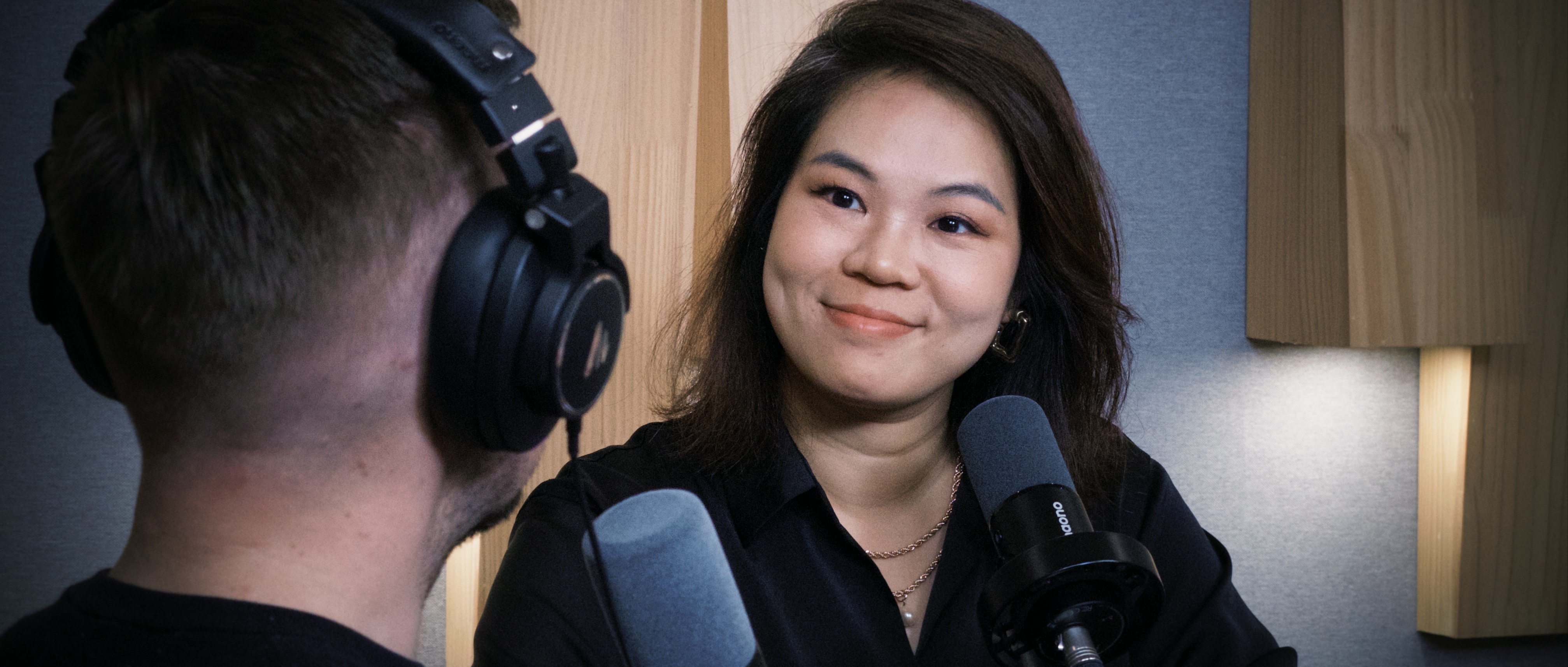
Denise Wu is the Founder & CEO of rootique, a Shenzhen-based scalp care tech company. Before rootique, she launched Foodpanda in Hong Kong as the first team member, scaled bluegogo's US operations, and worked at Ogilvy in healthcare PR. She joined InnoX in 2025 and is closing her angel round in early 2026. Her product, rootique DUO, is the world's first one-handed micro-misting scalp care device, now on sale in the US and Canada.
[00:00] Denise: I started my career in Hong Kong. I was in Ogilvy. And then before I joined Foodpanda, I was actually hijacking from Yunnan to Tibet. Oh, wow. Yeah. And then something happened, actually changed my mindset. We had a car accident and I was lucky enough I wasn't in the car that actually get crashed. I was in the car, but the driver told me to change. And the second thing is that I lost all my money and my passport, my ID when I was in Tibet. I was hiking there and I lost everything. I hike back. I met a monk in a, in a temple. I said, oh, I lost everything up there when I was hiking. He was like, congratulations.
[00:00] Thomas: Great.
[00:01] Denise: Okay.
[00:02] Thomas: So Denise, welcome to our podcast.
[00:04] Denise: Thank you so much for having me.
[00:05] Michael: Yeah, great to have you here.
[00:06] Thomas: Yeah, we are very looking forward because we talked on the phone a couple of days ago and there was a lot of interesting stuff you told us. One was, I wrote it down. She said if you want to succeed in Shenzhen, you have to be kind of bipolar. You have to scream at the suppliers in the morning and be their good friends in the evening.
[00:29] Denise: Yes. Yeah, yeah.
[00:31] Thomas: So you have a lot of stories to tell, I think.
[00:33] Denise: Yeah, yeah, yeah. Because I, I, I consider myself as a pretty gentle and well educated person before I entering the hardware industry and then so in the first two years of my business, I spent almost like half of my time in the factory and then deal with people in the factory was actually extremely challenging. I, I had some advisors with me back then, so every time I would have a problem I just send a message to them and say, hi, hey. They, they, they, they throw me this problem again and how, how can I solve it? And then they, they, of course, they, they, they have been really helpful and in providing advice to me, provided a lot of advice to me, but I have to encounter that problem. So it's like at the very beginning I was like, because you know, when we're working in the companies, we usually trust the vendors or the partners we choose from. So from day one, I talked to my found, I talked to the manufacturer partner, I say, okay, I choose to work with you, so I trust you would actually go through a problem with me and then you can help me solve the problem. But it just turned out not like that, you know, like probably like three months after that it was like, okay, shit, something happened, they're in. And then I start to go into the factories. I went there during like the work days, I went there during the weekend and I buy them like biscuits, coffees.
[02:04] Michael: You know, you started reaching out to them first via email or WeChat basically, and then you try to solve problems via WeChat until you found out this is not going to work. I have to be on the ground.
[02:17] Denise: Yeah, I have to be there, control every details right there and then shout it at them and then send it. So I was sitting really, really nice at the very beginning and then after that I was just like, I can't show it right in front of camera. But I was just doing that and I was like.
[02:35] Thomas: Okay, we have to beep this out, sensor this out.
[02:38] Denise: Yeah. And so the first experience with the manufacturer actually told me that if we are in the hardware Business, literally. I think it's better to consider in the Chinese saying. Right. Chinese, you always say like you gotta be gentle first and then. But I think in the hardware industry it's better to send me Holy.
[03:06] Thomas: Ah.
[03:06] Denise: Okay.
[03:06] Thomas: Yeah, yeah, be like, be like the bad guy or the bad girl first and then you can be nice. Okay, before we, before we talk about this, let's talk about the product. And this is also something I find really interesting.
[03:21] Denise: Yes.
[03:22] Thomas: Because as for a lot of founders, you have the same stories.
[03:26] Denise: Yes.
[03:26] Thomas: You tried to solve your own problem.
[03:30] Denise: Yeah, exactly.
[03:30] Thomas: A problem you encountered in life and then you found out, wow, it's a billion dollar industry. Right?
[03:37] Denise: Yeah.
[03:37] Thomas: So what was your problem?
[03:40] Denise: I personally suffer from hair loss since I was teenage. So that was during high school, around the age of like 17, 18. And my mom, to start with, my mom bought me a lot, a lot, a lot of like supplements, hair shampoos and etc. And nothing worked. But I, I mean I, I after that still like in the past 10 years, I spent a lot of time figuring out the solutions, et cetera, but nothing worked out. And it was until, so there was a turning point that made me to start do something around that. It was, I think it was like 2018 or 2019. I was on a business trip to Paris. No, Paris, sorry. On a business trip to Annecy, France. And then my colleague took a photo of me just beside the lake. Annecy lake was so beautiful. And then I can see my hair was like thinning, you know, literally was like stick on my scalp. And I was like so depressed after that. I was so sad. And I never took a photo after that and, and I was like, okay, because I know I, I, I will start my own business along the way. Even though I was working for startups and I was like, okay, if I want to do something, I gotta do something I believed in and I gotta do something I trusted. So there's a model on my LinkedIn I wrote all the time keeps. There is like, so I want to do something good to myself and do something good potentially can solve many problems, solve some problem into to the world. And so, so yeah, and then I started Routique in 2023 and to officially like get into this industry by myself, but before that I was actually selling hair loss comps in the Chinese market. So we saw like around more than 10 million revenues.
[05:40] Michael: But that wasn't your own business.
[05:42] Denise: That wasn't my own. Yeah, we were more like incubated in a, in a company.
[05:47] Michael: So you were always already in the industry. And you knew because I mean obviously many people talk about it that this is the problem. But how do you actually evaluate the size of the problem?
[05:57] Denise: Yeah, yeah. I think when we first. So when I first joined this industry as a SA department head and they started working around that, I know it's a big issue because I myself suffer from that. So proportionally if I'm suffering from that, 1/6 of the Chinese people are suffering from that. Probably 1/5 of the people in the world suffering from that. Then there's a potential. But the biggest challenge is that. So firstly there are only few FDA approved methods to treat hair loss. And then secondly is that I also scouted the manufacturing industry for two years before I developed boutique. So during that period of time already doing my own research. So I saw that there are a lot of products available in the market. But the product there, they are really close to it. I mean there's so many similarities. They're not really solving problems. Right. Like they're red light, they have red light, they have massage, they, they have this roller to apply the serums. They, some people just put, I mean they try to make combinations between these three functions. Right. Change the CMF and then sell it to the people, sell it to the customers. But the biggest challenge in this industry is that what I realize is the compliance is actually really low. Only a little like more than close to like 90% of the people who suffering from hair loss they stopped the treatment before seeing any results.
[07:35] Thomas: Yeah. This is a big problem like in all, in all areas of life.
[07:39] Denise: Yeah.
[07:40] Thomas: People go to the gym.
[07:44] Denise: Consistency is the key in, in this because I myself consider like hair loss or scalp treatment but we, because we were talking for like a larger audience of a scalp health. So it's a long time commitment. Yeah.
[08:00] Michael: So yeah, people are like impatient. It's always the same. Like I know it's exactly, I know from my mother too. She's like ah, I'm trying this supplement today because this is to be okay. It's for my gut health. Right. She's trying this for a week and then it's not working. I jump to the next thing and then like how can you expect a good result after one week? So you say long term commitment. How long does it actually take?
[08:28] Denise: It is pretty much depend on the hair and tonic our customers choose. But roughly around at least, at least three months to see a little bit of the progress. Positive progress. Yeah.
[08:40] Thomas: So let's break it down. So what you did is not just creating another product to help you prevent hair loss, but it helps you to develop a habit or to make developing a habit easier. Right. So yeah, tell us about your product.
[08:56] Denise: So this is the world's first micro misting scalp care device where because for people who are using hair tonics, right. The previous experience, they have to polyhair first. Right.
[09:09] Thomas: So people who suffer from hair loss, they will buy some tonics.
[09:14] Denise: Tonics, yeah.
[09:14] Thomas: And then they have to apply it on their scalp, Right. Not on the hair.
[09:18] Denise: On the scalp.
[09:19] Thomas: On the scalp, yeah. Okay. And then they have to do what you just did, right?
[09:24] Denise: Yeah, they drip it and then most of the tonic goes to the hair instead of the scalp and it drapes all the time. The experience was such a mess. So people. So firstly because it's so messy and then so complicated to use, so people got refused it automatically. And then secondly is that the. It lost a lot of it wasted a lot of tonic. And then thirdly, like the, the absorption rate is actually not as good. So you have to massage it in and try to make absorbed. So what we trying to do is that we want to change the whole experience, make it much, much easier for people to stick. Stick to. So we turn that into like 15 seconds experience where people just put a tonic in, turn it on and then slide it back. That's it.
[10:10] Thomas: Oh, okay.
[10:11] Denise: So it's like 15 seconds and that's done. Cuz most of the tonic goes to the scalp and then even if they want to use in the morning, it won't mess around the hairstyling. You know, you can just go out. Yeah. Directly.
[10:23] Thomas: So you managed to make a medical treatment as easy as just brushing your teeth. Or even easier.
[10:32] Denise: Right, exactly, exactly, exactly. I think we what the whole, our whole company's mission is to make scalp care much easier and effective for everyone. Where this experience can turn into a lifestyle instead of a medical treatment process. Yeah, so that's our mission and then that's why we developed this first one, first product.
[10:59] Michael: So you're coming from this comp company, right, where you detected. Okay, because this is very similar from the movement. Right. You're just applying the comp on your hair. So how did you come up with this solution?
[11:11] Denise: Oh, with this solution. Oh, oh, that was an interesting story actually when I first noticed there's a need for hair tonic. Right. I started to dive in and see like if there's any method people are currently using. And so I bought all the different devices available in the market to try out myself. I mean I was using some before, but I just like bought More. And I also bought the. A whole bunch of skincare products. Skincare devices. And.
[11:43] Thomas: Oh yeah, they're for the face.
[11:45] Denise: Yeah, yeah. And because I personally, I went to head spots every week, so I know how they take care of my scalp, you know, so in the head spots they have this kind of thing, help you to spray the tonic on the tongue on your scalp. I was like, okay, is there any way that I can bring that to a home based small device where people can use daily?
[12:08] Thomas: So they use a big device.
[12:09] Denise: Yeah, they use a big device.
[12:10] Thomas: Okay.
[12:11] Denise: Yeah. So. So that's why I was. Okay. Then we just come up with this idea to start to craft this product.
[12:17] Michael: But the technology from this big device and this is now similar. Or is there.
[12:21] Denise: There's a little bit some similar similarities. But the challenge is that this, they're big device, right? If we want to make it small, we have to find the small, small motors. Right. And then small solutions. And then, and then the, the biggest challenge was. Wasn't actually on the. I mean the, the mechanic design was quite challenging. But the biggest challenge we encountered at the very, very, very first step was how can we make this as easy as possible? Because in, in the spas, right, they. So there's someone serve you and then they will help you to part the hair. So we're thinking like, okay, how can we make people part the hair without using two hands? Okay, they can use it one hand directly. So, so we for this, this design actually took us half a year to come up with this trace. Okay, yeah. So when you see like you just part the hair first.
[13:17] Thomas: Ah, yeah, it does, it does part the hair.
[13:20] Denise: Yeah, yeah. So you part the hair first and then the mist coming out from the.
[13:24] Thomas: Sorry. No worries.
[13:25] Denise: So. So the mist coming out from the 2 nozzle.
[13:29] Thomas: Ah, okay.
[13:31] Michael: Maybe you can explain a bit how this actually looks. The, the comp thingy.
[13:38] Denise: This.
[13:39] Thomas: So, so this is like you have a comp.
[13:41] Denise: Yeah.
[13:42] Thomas: As a detachable. Detachable.
[13:46] Denise: Yeah.
[13:46] Thomas: And then you have like two nozzles, right, where the mist comes out.
[13:54] Denise: Yeah.
[13:55] Thomas: And you put your. So people, they buy their own tonic, right?
[13:59] Denise: Yes, exactly.
[14:00] Thomas: The most famous one. How is it called in English?
[14:05] Denise: Okay, yeah.
[14:06] Thomas: And then there's also some in, in China, very popular. Milo.
[14:09] Denise: Dr. Oh, exactly. Miladia is the, is the, is the ingredient.
[14:13] Thomas: It's the ingredient.
[14:14] Denise: Okay, yeah. So how's it called in English?
[14:18] Thomas: Okay, so this is the most famous ingredient. Right. So people buy the tonic, the tonic they love with the ingredient, they all can put it into your device.
[14:31] Denise: So they can put it here and then. So yeah, just put it right there.
[14:35] Thomas: Okay.
[14:36] Denise: Yeah, yeah.
[14:39] Thomas: So let's go back to the market. So as we said, like you had the problem you own, but actually hair loss and preventing hair loss is a huge market, right?
[14:48] Denise: Yes.
[14:48] Thomas: Do you know, do you have any numbers? Do you know how huge it is?
[14:52] Denise: Yes, they're roughly so one out of six people in China and one out of five people in the US and then overall that's around. Sure is 1.2 billion.
[15:08] Thomas: Wow. So it is a. It's a billion people. Billion customer market.
[15:15] Denise: Yeah.
[15:15] Thomas: And then multi billion US dollar market.
[15:19] Denise: Right? Exactly, exactly, exactly. And a billion. I think it's growing as well. I think interestingly, is that the people who are suffering for hair loss, they are getting the demographic. The demographic is actually getting younger and.
[15:34] Thomas: Younger and also suffer from hair loss is the right way to say it. Because a lot of people suffer. Men also, the same as women, get super popular.
[15:47] Denise: Are you ancient about getting. I mean you guys get perfect hair.
[15:51] Thomas: What do you think? Like me, I'm almost 40. I think it's okay. Right?
[15:54] Denise: You're doing really well.
[15:56] Thomas: My father is now 70. 73.
[16:00] Denise: Yes.
[16:01] Thomas: And he quite has. He has a little bit hair loss, but it's okay for 73. So I'm not that worried.
[16:07] Michael: I still have problems with these. How do you call it?
[16:09] Thomas: These? Yeah, I don't know.
[16:12] Denise: Yeah.
[16:12] Thomas: This one. How do you call it in England.
[16:16] Michael: Right? Yeah, I think it's still good. I have enough hair and it's still.
[16:21] Thomas: That female beauty standard. It's still long hair, nice hair. I think for women it's even more. It's even a bigger challenge. Right.
[16:29] Denise: It's different. Actually it's quite interesting when we look at the journey of female and male, like for female, like we have. We feel anxious about hair loss so much earlier. That's almost like day to day. Like every time when we shower. Right. Wash our hair. If there are more, we just want to do well See, that's the whole world craft.
[16:53] Michael: But during your market research, what is like, did you also come up with the why this is a problem or is this like something that is increasingly becoming a problem and what is causing this hair loss nowadays?
[17:07] Denise: I think beauty standard is definitely one thing and secondly is that I think people are like, we, we all experience this. People pay more attention about their face. Right.
[17:17] Thomas: I mean the awareness is like the, the question is like how. Why is it that hair loss is a bigger problem because of nutrition or lifestyle?
[17:26] Denise: Lifestyle. Yeah. I think it's overall because firstly hair loss was affected by 60 plus genes DNAs. Right. And so it's really, really complicated. But when you look at why is this demographic getting younger and younger. One of the few reasons. There are a few reasons is that one is the lifestyle. People sleep late, they stay up, always stay up. Right. And then the, the pressure is also one of the issue. Weather is actually affecting it Water. Right. Like nutrition as well. So there are all and all different things affecting.
[18:06] Michael: But that's funny, I mean nowadays I would assume people get, get more and more aware about their health. Like there's so many healthy like or healthy products out there that you can improve your life. Why is nutrition actually getting worse and then affecting your hair? Like I mean people care more and more about their health and lifestyle at least what I feel like but not the majority.
[18:34] Thomas: Right. Like because we are now in a, we're living in a world where there are more people obese or overweight than not. So it's like 51% of the world population is overweight. So which means they're, they're not having most of the time it means not a healthy, healthy lifestyle. Maybe in your bubble people are. Yeah. So I think and actually maybe some environmental issues. I think this also like polluted water, polluted air and these are all long term. So because now we are getting healthy, we're getting better air, better water. Especially in China we see it. But I guess there are some long term effects from like decades ago. Could be. This is my guess. We are, I'm not a scientist but.
[19:19] Denise: I'm not a scientist as well. But I think my, my, my own theory is that people do pay more attention to their health but fundamentally every they, I mean people is people are lazy.
[19:33] Thomas: Yeah, that's true, that's true. That's right. Because it's just like part of our human nature.
[19:39] Michael: Yeah. It's also fast pace everything and you want to have fast results and if it's not then you're getting disappointed and get off.
[19:45] Denise: Yeah, yeah.
[19:46] Thomas: I mean when you read James Clear Atomic Habits for example, like he tells like how hard it is to actually incorporate new habits into your life. And even for me it's like I think sometimes I'm very self disciplined. I lost so much weight but still it's so hard to incorporate good and healthy habits, new habits in my life.
[20:06] Denise: I actually have an experience to share because I lost 20 kg from I think in the past two, three years. Two, three years. But I came back a little bit. I came back a Little bit.
[20:19] Thomas: Oh, same for me. It's always going up. Always going up.
[20:23] Denise: I can play a little bit, but I never succeed in losing weight before. But I, and then, but during that two years, the only thing, only I only did two things. One is I, I did fasting. So I did like 18 hour fasting and then I did, I do, I did yoga two to three times a week.
[20:50] Thomas: Yeah.
[20:50] Denise: And that's it.
[20:52] Thomas: Yeah, yeah. And so it's great that you said, okay, you want your product to help people to incorporate these habits.
[21:00] Denise: Yeah.
[21:01] Thomas: Because sometimes you need some outside support.
[21:03] Denise: Yeah. Because from my experience of losing weight, I think incorporating a habit into the lifestyle is extremely challenging. And then, but the first, the first fundamental theory is that you can't go against people's daily routines.
[21:18] Thomas: Yeah.
[21:18] Denise: So for myself, I, I, the, I think one of the reason why I, I can do 18 to 18 hour fasting was because I finally realized that I can't quit my dinner. So I quit my breakfast.
[21:32] Michael: Yeah.
[21:33] Thomas: That's what I was, what I did. Right.
[21:35] Denise: So I thought, okay, that's my routine. So I, I just don't force myself to quit dinner. So I quit my breakfast and that was so much easier for me to stick to that. And, and then, and then I put that into when I was developing the product and then, and all our product lines, I was like. So I talked to my R and D partner and I was like, okay, the thing we're thinking about is that how can we incorporate our product into people's routine instead of reminding them to use our product? You know, that's another thing even because currently we are also developing new products in our company. We have a second generation iteration of this Duro coming out probably later this year and we have a new red light product coming out as well. And everything we think is that okay, just get people to start using it without a second thought. Of course, this one they still need to think about to use, but it's already in their routine. Right. Yeah.
[22:36] Michael: So how long did it take for you the, to do the R D? Basically until you come up with the solute or a potential solution that would.
[22:43] Denise: Be, I think the very beginning of R and D concept proof was quite fast. That was like six months. But the first product was so long. That was like two to three years already. But when we were expecting the next product, it would probably six to 12 months. Yeah. Yeah. Because we have the foundation for that already. But if not, that's. Yeah, because we, we developed two set of modes. Right. The first, first, first set of mode fighting with the factory, etc. Etc. Doesn't work out. Okay, let's move. Second one. Yeah, yeah.
[23:28] Thomas: Bipolar, Denise.
[23:29] Denise: Bipolar. Yeah.
[23:30] Michael: How did, how did you produce the first mold? Did you just use like 3D printing or what was your approach?
[23:37] Denise: We actually did the official molding. So that was like 300,000 RMB for a set of mold.
[23:45] Thomas: Oh wow.
[23:45] Michael: Okay.
[23:47] Thomas: So you, you had. Or you already had investors at that time or you just.
[23:51] Denise: I spent my own money.
[23:53] Thomas: Okay.
[23:54] Denise: Wow. Yeah.
[23:55] Thomas: So. And one step back, when you have a background in marketing, you work for Foodpanda and other companies, big corporates, startups, and why the heck would you think of doing a hardware. This is a hard business, right? Bipolar probably. Bipolar.
[24:12] Denise: Yeah, yeah, yeah, I think it was. I. So this little story is before I getting into hair loss industry, I was thinking about doing sustainable shoe shoes. Yeah. Because I'm from my. I. I'm from Fujian province and then Fujian is famous for shoes like the Anta and all that brand. So I was about to do, thinking about doing that, but. But that didn't work out because I asked my high school mate to come join me together and they feel like, okay, we're good friends but we can't do business together. Okay, that gave me a lesson. I never asked my friend to go do business together with me anymore. And, and when I get into this business it was because I know the solution I want to solve. And then there are different approach to do that, right. So firstly I can do a shampoo brand, which sounds easier for me, but it's extremely competitive. But a shampoo brand. And the secondly is to do a medicine brand, produce Milositol, all that they can help people, help solve the problem. Third is the hardware or software problem software to build up an ecosystem. And so there are three paths in front of me to choose from. So first path of working on a shampoo brand, I say no was because I'm not a chemistry, right? And then the thing it works is that we need to find a really really good component, a really, really good ingredient that worked. And so I don't think I can do that. Secondly, and second path is a medicine path. So it's more like a medical path. And I think I will leave it to professional dermatologists to figure that out. And so then, then there's the third path. And so I think third path for me was much, much easier. I don't know because I'm personal. I, I like to, to. To play around with different gigs, right. Every time when I go shopping So I literally don't go shopping but if, if I go shopping malls, if I go to the shopping malls I usually just go to the electro at okay, how what are the new stuffs right there. So I think out of my personal interest or my personal need or the experience doing the hardware I have a stronger confidence I know what I can do and what I can make a difference there. Whereas the other two I don't think I can do anything amazing out there. So I choose the hardware path and more like an ecosystem path I would say. And I knew it was hard but I think the difficulty was more beyond that and glad I actually went through the hardest challenge and hardest part right now.
[27:19] Michael: But usually when you start thinking of a hardware product as soon as you approach the manufacturers you somehow need some sort of industrial design. Right. You're not industrial designer but these manufacturers they help you with the design or how did you.
[27:38] Denise: We had a. We actually have a. Had a product design house help us to come up with the whole design.
[27:45] Thomas: Oh yeah, we heard about it. There's one in Shenzhen. Very famous right?
[27:48] Denise: Yeah yeah, they feel really, really good. So I come up with a concept. I know what kind of a technology I want to incorporate into our product. So I go to the product design house and tell them my ide. So they, they, they and then they helped me to come up with this shape of the design et cetera. And then, and after that then we'll leave it to R and D. And then so the first one I was like I working, I worked out, I worked with the ODM company but the, the current version that we actually built up our whole R and D team to, to redo everything. So that was also a lesson learned I would say if there's anyone want to do innovative product. So many people approached me and say hey Denise, I know that you ever. You worked with ODN companies before and how was the experience and etc. I was like okay if you're wanting, if you want to do anything. So there are two approaches. Firstly if the, the product you want to do is already existing and you just want to do a little bit of innovation right there, then probably you can go to a factories directly and that might be efficient. All right. But if, if the product you want to do is definitely innovative is the best approach is still to hire the home team to, to. To. To build it up to create it. And then because there's so many problems that, that we have to tackle and we have to spend time on and working with the factories they because if the factories have their own kind of like clients. Right. The way they calcul I or return of investment is that how can they produce more products in this limited time frame? So if they encounter a problem, they're probably not willing to spend time to dig into the problem and find a solution. So that's kind of like my experience. So that's why currently we are building our own team. We have a mechanic design, we have a hardware design and to come up with a new product.
[30:02] Michael: And they are in constant contact with the manufacturer.
[30:06] Denise: Yeah, our partners. Yes, exactly, exactly.
[30:09] Thomas: So how is it being a female founder in this hardware, hardware scene? Is it. I would imagine it's very male dominated.
[30:18] Denise: Yeah, yeah.
[30:19] Thomas: How many female founders do you know in your field?
[30:25] Denise: There isn't that many, but in Innox, the incubator we're currently in, I forgot the numbers. I think they are eight or ten already. Female founders. Yes, yes. And as a female founder in hardware industry, I think you just gotta prepare yourself to be popular first.
[30:44] Thomas: Yeah, yeah, tell us the story. We started with this famous quote of.
[30:48] Denise: Yours because it's like you have to be, I think it's, I would say like there's, there's advantages of being a female founder in this industry. It can, because you can be solved, right? Yeah, you can. I mean that's, that's a really good weapon. Sometimes it is. Yeah, sometimes. But sometimes you have to be tough, right? And then, so right now what we do is that because my, my co founder, he's a, he's a guy, so he's a mechanic, designer. So right now he's like, he's dealing with all the supply chains and so I was like, okay, you go shout at them, please. Fight as much as you can. I will be your backup. Yeah, I got you.
[31:42] Thomas: So you need like you just play a good cop, bad cop, right?
[31:45] Denise: Well, yeah, so, so sometimes he play the bad cop and sometimes he played a good cop and then that's a, that's good role. But for me at the very beginning, I have to play both. Yeah. So I still remember like I told you the story like after, right after CES last year, I just realized that they not going to finish this, finish all the production of my product right before the Chinese New Year, New Year. And then back then I was in New York. So I just bought a ticket, fly back into, fly back in Shenzhen, went to the factories directly and put my luggage outside of the factory, went to the boss room, straight in and said what the hell are you doing to my product get me the man you promised and otherwise I'll just shut your electronic down.
[32:34] Thomas: So did it work? It worked, it worked.
[32:37] Denise: Yeah.
[32:37] Michael: So this product is now already on the market?
[32:39] Denise: It is available in the market right now? Yeah.
[32:42] Michael: For how long?
[32:43] Denise: It's just available this month.
[32:45] Thomas: Oh, okay. And you are already working on the second generation and then other products, right?
[32:51] Denise: Yeah. So this, this is the second generation.
[32:53] Thomas: I would say this is already.
[32:54] Denise: Okay. So the upgraded version and we're currently working on a AI version. Yeah, yeah, yeah.
[33:01] Michael: Okay.
[33:02] Thomas: How do you involve AI, the hit word?
[33:05] Denise: Yeah, because we, we think that it's really important for people to understand the scalp health at home as well. Because it's like for most of the people who want to improve their scalp health, it's more like a black box. You don't know, you don't know like what's happening and you don't know what kind of product you should use and you don't know like if the. It's actually making good progress as he promised. So we want to actually break, break this circle and make people to understand their scalp health better. So we want to incorporate AI a little bit into our device and where people can check their scalp health much, much easier. So currently developing it. Yeah.
[33:47] Michael: Cool. Like you did a lot of testing maybe then for, for a year or so. What is your promise? What is the success rate after what kind of time frame that I can expect when I use your product?
[33:59] Denise: I think the biggest selling point is the convenience and. Yeah. And the experience people can enjoy from using the device.
[34:14] Michael: So basically the success is more or less coming from the tonic itself, from the ingredient and your is just the technology to help to apply it.
[34:24] Denise: Yeah. And we have a, we have a laboratory tested absorption rate improvement. So which is like 3.5% compared with bare hands. Yeah. And then, but we, we, we haven't done any clinical trial right now but we do have customers come to back to us and say oh I, the barber told him that he has a better hair like so and then he said, he says that okay, the only thing I make a, I mean the only thing I change is that using incorporate, incorporate retake into the routine. So that might be the, the thing because if they use the hair tonic more consistently. Right.
[35:02] Michael: Yeah, definitely.
[35:02] Denise: And, and then our device is actually improving the absorption rate then theoretic. Theoretically that might work. But we, we will, we'll do, we are planning to do a kind of testing later on together with the some hospitals and then users as well to see. Yeah, because that's the feedback that we get from the customers right now.
[35:28] Thomas: So before you put it on the market, you also need to fix a price. I mean you know your cost, you know your R D cost and the, the production cost. How, how do you do it? As a rookie, if I want to put it on the market, I cannot just make up a price. Right?
[35:43] Denise: Yeah, yeah, yeah.
[35:44] Thomas: So how do you fix a price that shoots the market? For example, Northern American market, we did.
[35:51] Denise: Because there's no one doing that. So we, we are the first one. So we, we, we kind of like can define the price range. So first consideration is like the, the, the production cost. Yeah. So literally it's like the product production cost for, for hardware. Right. And then secondly is the, there's no benchmark for us, but we also drag through like the, the cost of the hair loss, the hardware in the hair loss or hair regrowth industry. And I see like the price range. So the price range it will be roughly around. For example like Caremax Hair Max is the, one of the largest brands right now for red light therapy. The price ranges from 200, 299 till like probably close to a thousand. The other helmet brands is actually more than that as well. So this another benchmark for us. And we also did a, a survey, we did a survey beforehands as well to ask people like how much are they willing to pay. And so we've, we found out like there's a lot of people, more than 50% of the people actually fall into from 100 to 200 price range. So we just get a middle like 149 USD. Yeah. And, and then which also can cover, cover our like production costs. So I think that's, that's kind of like the group range to go with. Yeah.
[37:24] Thomas: So and how important is it to have a big portfolio of products? Because now this is your hero product right now. But for all the companies, especially if you have investors, they want to have more products.
[37:35] Denise: Yeah.
[37:36] Thomas: How do you do decide on when and what to do next?
[37:41] Denise: Actually we have the, I have the product line map bulb.
[37:47] Thomas: Oh, you already have it?
[37:48] Denise: Yeah, yeah. The first day I started Routique.
[37:50] Thomas: Okay.
[37:53] Denise: Yeah, yeah. So we have a, currently we have a five year product roadmap already.
[37:59] Michael: Oh that's great.
[38:00] Thomas: Yeah, that's good. So how many products are on this roadmap?
[38:04] Denise: We have three product line. Yeah. So and then under that there will be four different products. Four to five I would say in five years. And then including hardware, software and potentially some subscription models that we actually incorporate later. On.
[38:27] Michael: So you're not planning to sell also the tonics?
[38:31] Denise: We might because currently we have some partners in Europe, they incorporate our device into their tonic. So but we, we are so currently we don't think we would do our own brand of tonic right now because like I said at very beginning, we are not good at putting the ingredients. So I think I'll leave this to scientists to come up with the ingredient that really worked. But we also would like to work with different Tony brands to do co branded ones.
[39:11] Michael: Yeah, definitely. You could also provide some data sooner or later.
[39:14] Thomas: Right.
[39:14] Michael: As soon as you have some user data that you can.
[39:18] Denise: I hope they would like it. Yeah, we love it because I think customers love it. But I'm not sure if most of the Tony brands will love it because if they don't have that data they would just say, okay, there's something probably you have this and that and that if they have more data. Right. So but I think that's, that's good to put things forward. Right, sure. We like to do that because we want to get this really, really transparent to customers and then, and then we can show that data to them. They can actually improve their ingredients to some specific segmentations. Right. And yeah, and then we would do so because the next generation we might have a subscription potential subscription model and then to incorporate that with already known brands like Rogaine. Right. Or other, other famous brands which people are already using. Yeah, yeah.
[40:17] Thomas: And the tonic or the different tonics were also one of your biggest challenges when developing this product. Right. Because we have to say it again, the people, they have their own tonic and put it into your product.
[40:30] Denise: Yeah.
[40:31] Thomas: But different tonics have different density, different ingredients so it's very easy to clock the system inside. Right. How did you solve this problem?
[40:43] Denise: So this model, the first model we came out actually had this problem that was quite challenging. And this version, the upgraded version, the second version we came out to actually solve that problem. So. So firstly is that the mechanic, the motors that we're using inside make it more compatible with most of the hair tonic available in the market. Even the thicker version is like oil. Yeah. It can dispense oil, but the effect, the misting effect is not as good. But most of the tonic available in the market should be, shouldn't be problem. And then anti cloggings that we have a lot of software designed inside to anti clog the. The. Yeah. And it should solve the crystallization issue and then just in case if people get that, it have that problem and it's Extremely easy to clean. So. So this kind of currently the, the version that we're working on, so it's compatible with more like 80 to 90% of the hair tonic available in the market. Yeah.
[41:49] Michael: So how do you clean this?
[41:50] Denise: Now they're just putting the water inside. So they can just put the hot water inside. We have a deep clean mode. People can actually run that automatically. Automatically. And then we have a little tool for them to actually twist the nozzles down so they can actually deep clean that as well. So. And then the, the. The silicone cuts and just make it much, much easier.
[42:16] Thomas: So did you go to CES this year?
[42:18] Denise: No, I didn't, no. Yeah, yeah, yeah.
[42:20] Thomas: But your team.
[42:22] Denise: I was there last year.
[42:23] Thomas: Okay.
[42:23] Denise: Yeah, I was last year already with.
[42:25] Thomas: The first version of this product.
[42:26] Denise: Yes.
[42:27] Thomas: So what was the direct customer feedback?
[42:30] Denise: I think people are really exciting because they haven't seen any innovative product available in this, under this segmentation for a while. And so we get some really good channel feedbacks and potential channels that currently we're actually dealing with right now. So. Quite positive. Yeah, but I think that we were. We. And this year we should go to more like beauty expos or dermatologist exports, because those are more direct. Yeah, yeah, yeah, yeah, yeah.
[43:01] Michael: And now you're selling this product globally or did you just choose one specific region or the market first where you like? Okay, there's the problem. You said like, I don't know, in the UAE for example, there's the problem this. The market with the biggest problem. So you face this market first or you just.
[43:20] Denise: Our biggest market right now is still us. Okay. US and Canada, because the penetration for the hair tonic is quite high. The fret air and then middle is really accessible. Yeah. But the min is the. Is more is a prescription in Europe and UAE as well. That, this, that you need to go to the pharmacies to get that. Where you are in us, you just go to CVS and you can get it over the counter on the shelf. So that's why we choose to get into the US and Canadian market first. But it's available globally. People can get that directly from our website. And then we have some distributors in different regions. They are currently selling the product. Yeah.
[44:14] Thomas: And you already said you are part of the accelerator Innox right now and you said this is the second best decision after starting a business. So can you tell us a little bit, how is the ecosystem in these kind of accelerators in Shenzhen? How do they support someone like you?
[44:33] Denise: Yeah, I think Innox is they're not paying me by the way.
[44:38] Thomas: They're not paying us either. We're very good friends. Very good friends with them.
[44:45] Denise: Is a really, really very good ecosystem. Because the first biggest decision, the first best decision was that choose to start Rotiq. And the second best decision is to join Innox. That's the best hardware incubator in China I think might be also around the world. Because when I first joined the way it works is that innovation is specialized in hardware and then we have a whole mentor system supporting us and all of the mentors has the industrial experience. They are, they have a background from dji, Huawei, right anchor. So if I still remember like the first day I arrived, I encountered a hardware problem and I asked one of the mentor and say hey, I have a battery issue and then they have, they got extremely unstable and blah blah blah. And then he helped me went through all the problems I had and then, and then we solve that problem. So that was really helpful. And Innos has a really comprehensive support system from ideation to product development and then also product manufacturing.
[46:09] Thomas: So.
[46:11] Denise: The whole development phase that we've had probably because when we joined the incubator we already have the product, we already market proof the concept. So we actually got benefit from the product development, the support for the product development and also the MPI process. MPI is called New product integration. So we were the first team that did the MPI process in our lab. Oh wow. Yeah, yeah. So we hire the assembling workers part time ourselves and then put up the product line to our SOP directly and then so assemble the product from 00 to 1. So we did like 1000 set in that lab and then after that we moved to the manufacture assembling manufacturer to do the, to do the later on process manufacturing.
[47:19] Michael: So before you want to start Innox you already have to have a certain product ready or is it just okay? I'm like a good person. I have a great idea. I need someone who supports that. Maybe I found a co founder and Innox helps me with that. How is the process?
[47:36] Denise: So there are two because we are actually we get in from the most of the people in Innox they join the incubator from. There's a summer camp, there's a winter camp. Yeah. And then there are hundreds of people apply and then I got each camp they only select, I think it's like 60 to 80 people to join right. The camp and then after the camp there's a interview round and then to see like oh, whether they are really good firstly, if they are willing to do a startup, secondly, do they have the potential? And then they will select probably I don't know the exact number and then they will select a bunch of people to join Innox. So and then they will help them to sort out what kind of direction they want to go to and what kind of product they want to go to, what kind of product they want to develop. And then that's kind of like ideation phase. Yeah. So for the first ideation phase and then later on they will join the Innox officially if they pass the interview and they would get a 500000 RMB for the grant and. Yeah, and then just go through it. So, so besides the whole product development, I think you know, S is really, really helpful into a financial wise as well. Yeah, yeah.
[49:02] Thomas: It's around 70, 75000 US dollars.
[49:06] Denise: Yeah. So like something like this 5, 500,000. Yeah, yeah. R and B. Yeah. And so with that money most of the team can develop a demo. Right. So with the demo they can pitch to Professor Lee for, for the.
[49:25] Thomas: So he's still like really invested. I mean in the sense that he invests time and energy. So Professor Lee, he's one of the first investors of dji.
[49:33] Denise: Yeah, exactly.
[49:34] Thomas: Right. And now he founded Innox and now you still have the opportunity to talk to him on a regular basis.
[49:42] Denise: Yes, yes, yes, yes.
[49:43] Thomas: Okay. So how was that?
[49:44] Denise: Yeah, it was good. I really like Professor Lee. So each time when we met Professor Lee. Oh, there's a typical problem he asked us is that what, so why. He usually asks a few questions first. Why do you, why do you do this? Yeah. And then, so what's your target audience? Right, and then what was the biggest challenge that you face right now? How can we support you?
[50:09] Michael: Okay.
[50:09] Denise: Yeah. So, so, so I was like this, he's, he's really has a heart to support young generations to develop some like innovative hardwares. Yeah.
[50:22] Michael: And then so Innox, is it only for Chinese or is there also the possibility that.
[50:30] Denise: Oh, there's, there's also foreign foreigners right there as well.
[50:33] Michael: Oh wow.
[50:33] Denise: Yeah, yeah, yeah, yeah, yeah, yeah.
[50:35] Thomas: I saw they had like, like also, I don't know if they worked there but they had like Indian startups and so on. So people from different countries.
[50:44] Denise: Middle East. Middle east, yeah, yeah, yeah, yeah.
[50:48] Thomas: So where do you see yourself in five years? Will you still be in the accelerator or will you have your own office with 150 people looking for you?
[51:00] Denise: We're going to move to a new office in March. Or April.
[51:04] Thomas: Okay.
[51:04] Denise: Yeah. This year because we're closing our angel round.
[51:09] Thomas: Yeah.
[51:09] Denise: And then so after angel round I mean after we close the inter round we gotta move to a accelerator so we can't be in the incubator anymore.
[51:19] Thomas: Okay.
[51:20] Denise: So that would be a accelerator under Innox. So we move there and then so in five years I, I would definitely, I'm sure I'll definitely be in this industry doing hair loss sculpt care devices and I believe we have the three product line ready and then have an ecosystem ready for us team wise. I, I, I, I, I think I, I'd rather to keep it within like around 50 people. Yeah. Instead of 100 because I, I, I started a business with from one person and myself and then currently we have a people a team of 10. Right. And half of them are interns and part times and so so, so, so I think to keep it as a lean team and then effect efficient team is more important than have a bigger team where we have to manage a lot of like yeah. Spend a lot of time managing the resort. The, the, the, the, the, the thing.
[52:29] Thomas: So yeah you said you started this alone on your own. What is the one most important advice for someone who's listening to this podcast and is saying I also want to do a hardware startup on my own.
[52:46] Denise: Yeah. I mean start early. Yeah. Because to answer that question is let me think about that. How should I answer that? So one of the reason I was there to start the business on my own. There are there, I think there are a few criteria if I think back. So firstly I was in different startups so I know how the building something from zero to one and then also from one to zero.
[53:25] Thomas: Right.
[53:25] Denise: I experienced from one to zero the problems as well. Yeah. And then so I know what I was prepared for the problem and I was prepared for the worst case scenario. So I asked myself and say oh okay what was the, what would be the worst case for me? So the worst scenario goes like you lose all the money. I probably be wearing debt and but that's fine for me. So I, I think I confident that I can start again. So that's the first thing. Second thing is that so if I, if so that then I also ask myself, I say if I don't do this, if I, if this is something I have to wait another co founder to join me to make this succeed then that's probably something not something I, I not I mean I'm, I'm, I meant to do.
[54:23] Thomas: Yeah.
[54:23] Denise: You know what I mean?
[54:24] Thomas: So because you're dependent on other people.
[54:25] Denise: Yeah, exactly. So I was like, if this is something I can start by myself. No, no, I. And then I know this, I'm on the right path. So. And I, I'm lucky because especially when I think back, I feel really grateful. I didn't have a partner then. It was because if I had a partner, I would highly rely on this person to make decisions and then to figure out all the problems we encountered. So I won't be able to have the ability to grow my negotiation power with manufacturers to understand all this, every single details of supply chain. So, so I think that's a very, very good experience for me. But of course, if, if, if they already, if anyone who want to start a business already have a partner there, then that's awesome, right? You, you trust each other and then that you can rely on each other. You have someone to talk to and then to avoid your being becoming bipolar. No, just kidding again. So, so, so that's the two things I think is, is, is kind of important. But most of people, they got afraid of studying something alone, you know. Yeah.
[55:48] Thomas: Yeah. That makes so much sense. Number one, be prepared for the worst.
[55:51] Denise: Yeah.
[55:51] Thomas: Know the worst case scenario and then decide if you could live with it or not.
[55:56] Denise: Yeah.
[55:56] Thomas: And number two, be aware that you are the most important person as a.
[56:00] Michael: Founder and just execute. This is one of the most important rules or lessons we've learned also like. Yeah, do it. Just do it.
[56:08] Denise: Just do it. Yeah.
[56:09] Michael: Exactly as you said. What is the worst that can happen? You lose your money. Okay. Money comes and goes. Right?
[56:13] Denise: Exactly, exactly.
[56:15] Michael: How deep, how low do you actually fall? Right?
[56:18] Denise: Yeah, yeah, yeah. Because I, there was a life. So I started my career in Hong Kong. So I was in Ogilvy. And then before I joined for Panda, I was actually hijacking from Yunnan to Tibet.
[56:34] Thomas: Oh, wow.
[56:34] Denise: Yeah. So there was like almost like a two month time I was hijacking out there and then something happened. Actually changed my mindset. So there's so many things. So firstly we had a car accident and I was lucky enough I wasn't in the car that actually get crashed. Yeah, it just changed. I was in that car but the, the driver told me to, to, to. To change to the, the, the falling one because it was too crowded and I saw that car was like float from the mountain. But it was quite fortunate because no one get hurt. But I can't imagine that what would happen if I was in that car. Right. And the second thing is that I, I lost all my money and My passport, my id. When I was in Tibet, I was hiking there and then I lost everything. And then I was actually, to me it was fine. Right. So. And then I hike back, I hike back and then when I met a monk in a temple, I said I lost everything up there when I was hiking. He was like, congratulations. Yeah. Because he was like, oh, you, you came all the way, you spent all this time, you came all the way here to give the, give, give back something you treasure to the Buddha. So which means that you have a good luck later on.
[58:09] Thomas: Yeah, I mean it makes totally sense. Maybe someone will find the money who really needs it more than you.
[58:15] Denise: Yeah. Yeah, probably. Yeah. It was so weird because there was no one in the mountain. I was, and I wasn't able to find that. So, so this, the, the, so my journey, that journey actually make a huge impact in my life when every time when I make a choice, I was like, what's actually meaningful to you? And, and then, and then. Oh, there was a time a friend, also investor. So she was asking me that why I started a business. Right. And then what am I chasing? Am I chasing for the money when I'm changing the fortune or am I chasing the fall of fame or something? And I was like, all of that. No. Yeah. Maybe. Because my plan is I want to run the hostel afterwards in Tibet. In Tibet, probably for monks. Yeah, yeah, yeah. Because I'm a hostel person. I like to stay in hostels.
[59:11] Thomas: Okay.
[59:12] Denise: Yeah. Even now I usually, when I travel, I live in hostels. And I was like, yeah, I, I, I, I, I do this, I definitely chase a lot of things right along the way. I want to, I want to make this billion dollar company and then make myself financially free. Financially freedom. And I want to my make a impact on people who are using our products, get a fame. So that's the fame I'm chasing. And then the other thing is that for me, in the lifetime I was thinking about, so my experience in Tibet always taught me that life is short. So I don't know exactly what happened. So I might, I might die next second. Right. So if I die next second, what I actually left behind. So what's the sentence? I will leave on my thing that would be, be remembered. So I think that's something also kind of guiding me along the journey on say if every time when I'm making the decision. So that's kind of like the voice.
[60:22] Michael: Yeah.
[60:22] Denise: Behind.
[60:23] Michael: I highly resonate with that. That's also one of the reasons why I just left.
[60:27] Denise: Yeah.
[60:27] Michael: Germany quit my job last year and came here because I was like, ah, is this everything I want to achieve? Like, just going up the career ladder? Which is not wrong.
[60:37] Denise: Yeah, yeah.
[60:37] Michael: But I don't know. There was nothing really, for me, the meaning behind. Yeah, exactly. The purpose.
[60:44] Denise: Yeah, yeah, yeah, yeah. It's always. It's always no harm to try, right? Like, it's always no harm to try. And then as long as you put. I always. I always believe in one thing, is that as long as you try hard, if you don't get the goal, just try hard and try harder.
[61:05] Michael: At least you have the experience, Right. The experience along the way will just guide you somewhere you probably don't expect. And then at the end, you end up somewhere that you didn't know that there was a path.
[61:18] Denise: Yeah, yeah, yeah, yeah, yeah. Right.
[61:22] Thomas: What a beautiful ending of this conversation. Very philosophic. Denise, thank you so much.
[61:29] Denise: Yeah.
[61:29] Michael: Thank you.
[61:29] Thomas: Thank you so much for bringing your product, for bringing your stories.
[61:32] Denise: Thank you so much.
[61:33] Thomas: Bringing your entrepreneurial wisdom to us, and.
[61:36] Michael: I love the energy.
[61:37] Thomas: Yeah.
[61:37] Denise: So much. Thank you so much. Yeah.
[61:38] Thomas: See you very soon.
[61:39] Denise: Yeah.
[61:40] Thomas: In your hostel.
[61:42] Denise: Oh, my God. So one hostel is. The other one is get a boat and sail around.
[61:48] Thomas: Wish you good luck. Thank you so much.
[61:49] Denise: Thank you so much. Thank you so much. Thank you. Yep.
[61:54] Thomas: Wow, that was really nice.
[61:55] Michael: Yeah, it was great.
[61:56] Thomas: How did you like it?
[61:57] Denise: It's good. It's good. I hope it's not too random.
[62:01] Michael: Perfect.
[62:01] Thomas: It was like very round picture, you know?
[62:04] Denise: Yeah. Because we.
[62:05] Thomas: We don't want to be, like, just a tech part.
Founder Report
Get instant access.
Enter your email to unlock the full Asiabits report on DJI's alumni and the next wave of Shenzhen founders.


Get These Insights
Every Morning
Join 18,000+ professionals who start their day with Asiabits. Free, every weekday, straight from Shanghai.