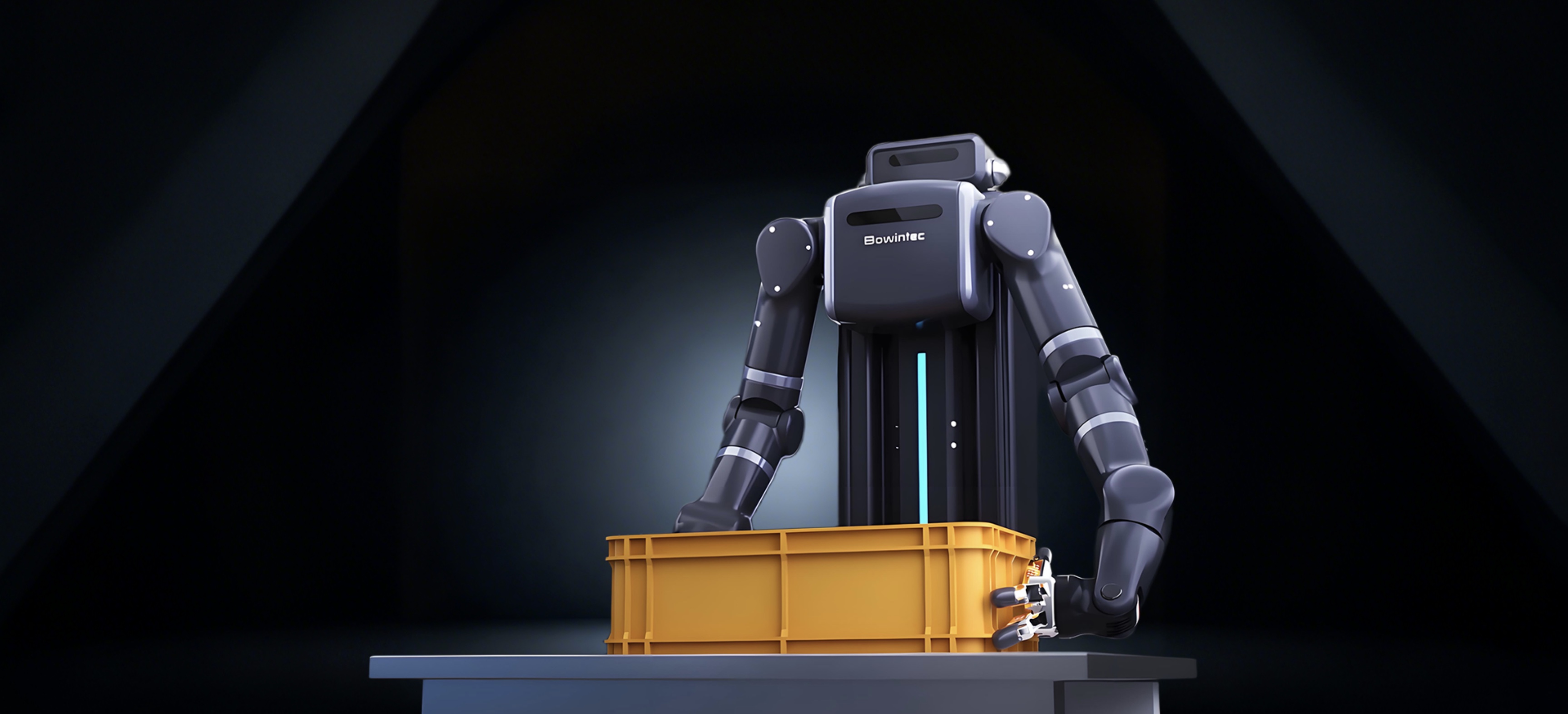
On the edge of Shanghai, I watched a robot practice a job that used to come with a plane ticket.
The work looked like nothing special. Two arms picking up a small part, seating it at the right angle, checking it, trying again when it sat a millimeter off. The kind of fiddly, two-handed task a line worker does by hand for eight hours before the next shift takes over. The kind that, when a new product launches and the line will not cooperate, puts a process engineer on a flight from Germany to babysit the machine for a week until it runs clean.
This robot is not on the line yet. It is still training. The arms get the same part wrong, adjust, try again, hundreds of times over, in a lab built onto a working factory floor. That is the whole idea. It learns the real job in the real place, instead of waving at a camera on a conference stage.
The robot comes from a company called Bowintec. The line belongs to UAES, the Bosch and SAIC joint venture that has built automotive electronics in Pudong since 1995. Together they run the lab, called RoboFab, where Bowintec's machines learn the work with the company's own engineers sitting right there on the floor.
What Bowintec actually is
Bowintec is barely a year old. It was set up in June 2025 as a joint venture between Boyuan Capital, which is Bosch's own investment arm, and Galbot, one of the Chinese companies out front on what the industry calls embodied AI. The plain version of embodied AI: robots that learn a physical task by doing it over and over, the way a language model learns from text, instead of being coded one motion at a time.
In May 2026 the company raised close to 300 million RMB in a Pre-A round. Oriza led it, and Bosch Ventures and Boyuan both put in more on top. For a company that did not exist eighteen months earlier, that is real money following real conviction.
What it builds are dexterous robotic hands and single- and dual-arm systems aimed at the work that has stayed manual long after the rest of the factory went automatic. Complex assembly. Quality inspection. The jobs the big caged arms that weld and lift in every car plant were never built to handle.
The use case: a robot that does not fly home
Automotive electronics is a hard place to put a robot. The parts are small, the tolerances are tight, and the line gets reworked every time a new model comes through. This is exactly the work that keeps pulling engineers onto planes and rotating workers through shifts.
Inside RoboFab, Bowintec's robots train on that work directly, on a real UAES line, not in a showroom. The bet is simple. Once a robot can hold the job, a new product means you retrain it instead of rebooking a flight. It does not fade at hour seven, it does not hand off to a second shift, and when the week is over it does not go home. None of that is running in production yet. But it is a far more honest test than a humanoid waving at a crowd, and the place they chose to run it tells you they are serious.
“From the very beginning of the company's establishment, we made it clear to develop products and delivery for real industrial scenarios, rather than staying at the demonstration or laboratory stage.”
Alex Ren, CEO, BowintecThe best argument for a joint venture is that nobody is forcing it anymore
For most of the last forty years, a foreign company that wanted to build in China did not get to decide whether to take a local partner. The joint venture was the law. You came in, you handed over half the company, and you shared the keys whether you wanted to or not. Plenty of Western boardrooms spent those decades resenting it.
Then China spent the last few years dropping most of those rules. Autos, the most symbolic industry of the lot, removed the foreign ownership cap completely. Bosch could do a lot of this on its own today.
It chose a partner anyway, on purpose. A new factory, Bosch can put up by itself. A company that grew up inside Chinese embodied AI, moves at startup speed, and already lives in the research happening here, it cannot. That company is Galbot. The joint venture used to be the cost of getting in. Today it is the smart move.
The robot is the easy thing to photograph. The decision behind it matters more: a company big enough to go solo, still wanting a local partner on the ground. Even Bosch.
What Western manufacturers should take from this
A few things worth writing down after a day on that floor.
Forget the humanoids on stage for a minute. The money and the first real deployments in China are going to the plain robotic arm on the line, doing the fiddly work the old machines could never touch. That is where the next decade of factory automation gets decided.
The Bosch setup is becoming a template. Foreign capital, Chinese embodied-AI research, inside a company that belongs to neither parent outright. Expect more of these, and not only in cars.
The timing is the uncomfortable part. If you are a manufacturer waiting to see whether this works before you move, the companies running these labs today are buying themselves a two-year head start while you sit on the fence.
Want to meet a company like this?
At Asiabits we track companies like Bowintec for a living. Our robotics directory follows more than 6,800 Chinese robotics and automation companies: who they are, what they actually build, and who is backing them. Bowintec is one of them. Tell us what you are trying to automate and we will point you to the people in China already building it.
Talk to Us →Bowintec's robots are still in training. The structure that built them is already working.


Comments (3)