Western YouTubers keep flying to Shenzhen. iShowSpeed live-streamed his trip to over 30 million viewers. Travel vloggers post the same Walmart-sized electronics market footage on repeat. And most of them only end up seeing Huaqiangbei, the SEG Plaza, and a Tencent lobby tour.
We live here. After ten years on the ground in China, we wanted to make a different list. Five places that show what Shenzhen actually does in 2026, not what makes the most clickable Shorts.
This article is the long version of the city tour. The 10-minute video is embedded below. Skip to it if you prefer to watch.
From Fishing Village to 17.5 Million in Forty Years
Shenzhen is younger than most of the people working in it. In 1980 it was a fishing town of around 30,000 people sitting at the border with Hong Kong. Deng Xiaoping designated it as China's first Special Economic Zone that year, and the population started doubling every few years.
Today, Shenzhen is home to DJI (around 80% of the global consumer drone market), Huawei, Tencent, BYD, BGI, Mindray, Hytera, SF Express and the listed parents of dozens of companies that supply Apple, Tesla, and most of the consumer electronics on your desk. The Shenzhen Stock Exchange is one of two mainland Chinese exchanges. The port handles more containers than Los Angeles and Long Beach combined.
If you sat down to design a city for hardware, you would design something close to Shenzhen. Component sourcing, prototyping, mold-making, PCB assembly, contract manufacturing, logistics. All of it is within a two-hour drive. The phrase you hear from founders here is "a week in Shenzhen equals a month anywhere else." That is not marketing. It is a fact about how dense the supplier network is and how fast iteration cycles run.
Why Shenzhen Is Not Like the Rest of China
Three things make Shenzhen different from Beijing, Shanghai, Guangzhou, or Chengdu.
1. It is a migrant city. Almost everyone working in Shenzhen came from somewhere else. The average age is around 33. The local Cantonese-speaking native population is a tiny minority. That makes the culture more open to outsiders, faster to change, and far less hierarchical than Beijing or Shanghai.
2. It is next door to Hong Kong. Capital, talent, and ideas flow across the Lok Ma Chau border in both directions. A founder can incorporate in Hong Kong, manufacture in Shenzhen, and sell globally without changing time zones.
3. It was built around hardware, not finance or government. Beijing has the regulators. Shanghai has the banks. Shenzhen has the factories, the engineers, and the supply chain managers. When you walk into a coffee shop here, half the conversations you overhear are about BOMs, lead times, and component shortages.
Five Places That Show How Shenzhen Works in 2026
The five spots below were a working day for us, not a tourist itinerary. We started at 10am at Talent Park, ended at 9pm watching the Futian skyline play a synchronized light show, and got everywhere using a mix of Pony AI robotaxis and the Shenzhen Metro.
Spot 1. Talent Park: Drone Food Delivery and Robot Coffee
Talent Park sits in the Nanshan district, the part of Shenzhen where most of the tech companies cluster. It is officially a public park. In practice it is a live-test site for everything Shenzhen ships next.
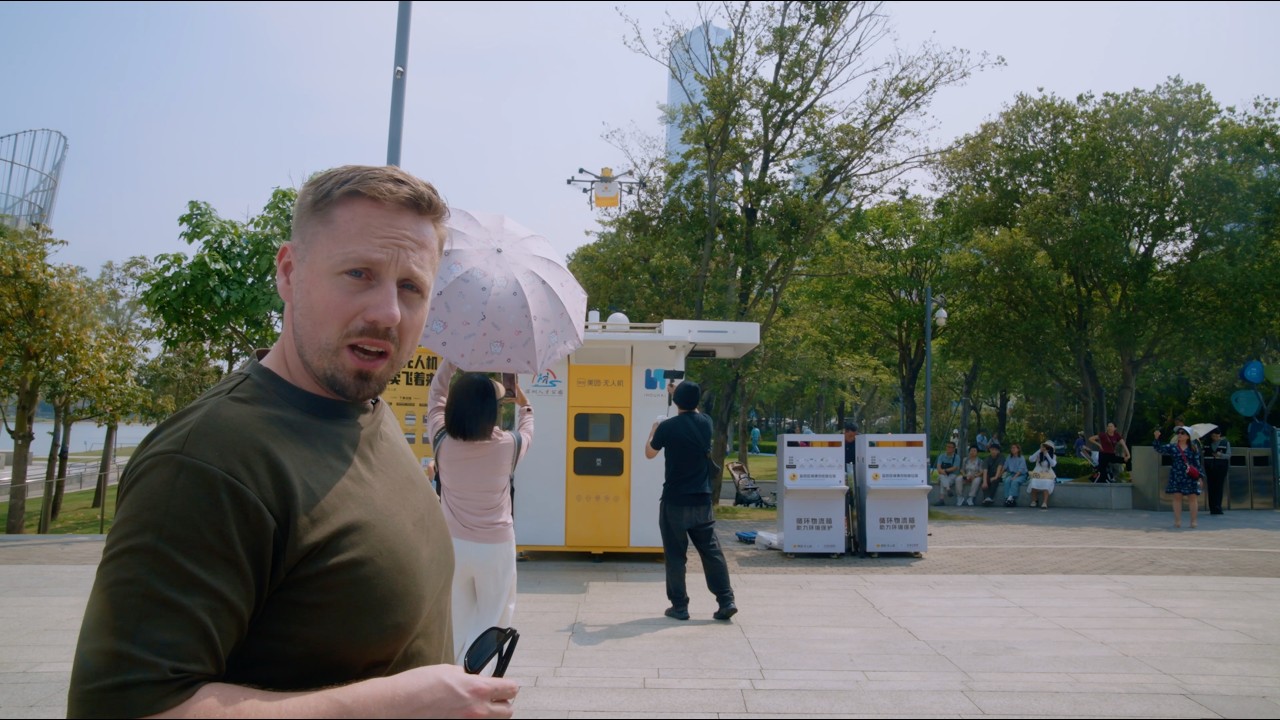
The drone food delivery station works like an outdoor vending machine. You scan a QR code, you pick from a menu of around eight options (KFC, McDonald's, noodles, milk tea, healthier Chinese options), and a drone lands on the rooftop launchpad with your order in a sealed cardboard box. You enter the last four digits of your phone number, the box opens, you eat. The whole loop from order to landing takes around fifteen minutes during normal load.
It is not a stunt. Meituan, the Chinese super-app, has been running drone delivery in Shenzhen since 2021 and crossed 200,000 commercial drone deliveries in 2023. Talent Park is one of the most visible nodes.
A few hundred meters away there is a fully autonomous robot coffee shop in a glass cube. Two robotic arms make espresso, pour the milk, hand the cup over a counter. The funny thing is that two human staff are still working in there alongside the robots, refilling beans and clearing the queue. We are close to humans-out-of-the-loop. We are not there yet.
The company running the coffee robots also raised around 1 billion RMB in its most recent round. You will see Chinese families with toddlers hanging out around the robots on weekends, the way kids in Germany hang out at the Lego store.
Spot 2. Inno100: Where China's New Hardware Lands First
Inno100 is a private hardware showroom. The slogan they use is "there is always something new", and on most weeks that is literally true. Whatever just shipped in the Chinese hardware ecosystem ends up on a shelf here within a few weeks of launch.
On the visit we walked past 3D printers in the 10,000 USD range that handle resin, FDM, and large-format printing in one machine. There was an automatic chess board where motorized magnets move the pieces while you play against an AI or watch grandmaster matches replay themselves. Phones with full-color displays embedded in the back panel. Wearable cameras the size of a coin. We saw the new Carl Pei Nothing phone, manufactured in Shenzhen, before most US reviewers had a unit.
For Western product teams, a place like Inno100 is one of the highest-bandwidth ways to spend two hours in this city. You can compress six months of trade show coverage into one walk-through.
Spot 3. A Pony AI Robotaxi Across the City
Between stops we ordered a Pony AI robotaxi to OCT Harbor. A Pony.AI-branded SUV pulled up with no driver. We got in, fastened our seatbelts, watched the steering wheel turn itself.
The tech itself was almost incidental. What stuck with us was the conversation we ended up having on the way there. Once you imagine a city where every car is autonomous and every car is on the same network, traffic jams stop being a transport problem and become a software problem. Trains do not have traffic jams. Once cars start talking to each other and to traffic lights, neither do they.
Shenzhen has been one of the most aggressive cities in the world about giving robotaxi companies real road access. Pony AI, Baidu Apollo, and AutoX all run commercial fleets here. You can order a robotaxi from your phone the same way you order a Didi.
Spot 4. The DJI Flagship Store at OCT Harbor (4,000 Square Meters)
OCT Harbor is a waterfront mall complex in Nanshan. The DJI flagship inside it is, by their own claim, the largest DJI store in the world. It is 4,000 square meters of drone showroom and product museum. Entrance is free.
DJI is the company that turned Shenzhen into the global drone capital. The story of the company is worth knowing. There used to be a US-based consumer drone company called 3D Robotics, founded by the former editor of Wired magazine. It raised over 100 million USD in venture capital. DJI shipped a better product at a lower price out of Shenzhen, and 3D Robotics had to exit the consumer market entirely. Today DJI holds an estimated 80% of the global consumer drone market.
The flagship store is structured like a museum. One wall holds a full-size diagram of how a drone actually works (motors, gimbal, optical flow sensor, GPS module, RF link). There are working units of every consumer drone in the lineup. There are professional cinema rigs on the second floor. And in the back, behind a glass wall, there is a delivery drone that can carry 30 kilograms of payload across short distances. The sales agent showing it to us pointed out that it can carry a Labrador in a transport box. We asked whether anyone had actually ordered a Labrador delivery. He smiled and did not answer.
Spot 5. The Xiaomi Flagship: From Vacuum Cleaners to Supercars
Two minutes' walk from the DJI store, Xiaomi runs a flagship of similar scale. The first thing you notice is the cars. Right inside the showroom, between a wall of robot vacuum cleaners and a display of cookers, sit two production EVs. The SU7 sedan, designed visibly inspired by the Porsche Panamera, and the YU7 SUV, with a silhouette closer to the Ferrari Purosangue. There is also a track-spec SU7 Ultra, the one Xiaomi used to set lap records at the Nürburgring.
It is a strange thing to see for a Western visitor. You would not walk into an Apple store and see a car parked next to the iPads. But Xiaomi's whole pitch is the ecosystem. Phones, watches, vacuum cleaners, air purifiers, rice cookers, EVs, all running on one app. They sell every category in the same store, often with bundle pricing, often with products that simply are not available outside China.
One small detail tells the whole story. Some Xiaomi phones now have a small color display embedded in the back panel that you can use as a viewfinder when shooting selfies with the main rear camera. That feature was designed in Shenzhen, sells in China, and almost certainly will not be in the international SKU. If you want the cutting edge of consumer hardware, you have to come and buy it here.
What This Means for Western Companies
The slow-motion realization for most Western executives who visit Shenzhen for the first time is that the city is not catching up with the West. It has been ahead in specific categories for years, and the gap is widening.
If you build hardware, sourcing components and prototypes from Shenzhen is no longer optional. Consumer brands have to track what Xiaomi, Anker, and Insta360 are shipping months before it reaches their home market. And anyone running autonomous fleets has to benchmark against what is happening on Shenzhen roads right now.
None of this requires moving operations to China. It requires a way of seeing the city that is not filtered through a Western YouTuber's two-day Walmart tour. That is the entire reason we built Asiabits. We give Western executives a reliable, on-the-ground view of what actually happens here.
Want to See Shenzhen for Yourself?
We design and operate single-day and multi-day China innovation tours for executive teams. DJI, Huawei, Tencent, BYD, Unitree, and the spots in this article. Twelve years of relationships, no tourist filter. Reach out and we will build a route.
Talk to Us →How to Actually Visit Shenzhen as a Western Executive
If you fly in on your own, three practical things matter.
1. Get on WeChat and Alipay before you land. Both apps now accept foreign credit cards for tourist accounts. Without one of them, you cannot pay for a coffee, book a metro card, or scan a menu in most restaurants. Cash is technically legal but will get you funny looks.
2. Plan around the cross-border. The fastest international entry into Shenzhen is via Hong Kong International Airport, then the high-speed train from West Kowloon to Futian Station (15 minutes). The visa-free transit policy for many Western passports has been extended through 2026 and is updated periodically. Check before you fly.
3. The good places are not in Huaqiangbei. Huaqiangbei is the famous electronics market. It is worth one afternoon if you have never seen it. The actual frontier is in Nanshan and Futian, in the parks, the showrooms, the company campuses. That is the orientation we use when we build tours for clients.
The Light Show Was the Best Part
We finished the day at the Futian skyline. Every evening for the past few years, a synchronized light show plays across around 40 of the tallest buildings in the central business district. Dragons fly across glass facades. Skylines turn into screens. Cantonese opera singers appear sixty stories tall.
It is not subtle. It is not understated. But standing at the foot of the Ping An Finance Center watching a skyline that did not exist twenty years ago play a coordinated 12-minute show, you start to understand the city in a different way.
Shenzhen is not finished. It is not waiting. It is in motion every week, and the gap between what is shipping here and what is in your nearest mall is the most underrated business intelligence story of the decade.
Come and see it. Or have us bring it to you.
This article is based on Thomas Derksen's on-the-ground reporting from Shenzhen, May 2026. Watch the full video tour on YouTube. Subscribe to Asiabits for weekly insider intelligence on China tech, robotics, and EVs.
Get These Insights Every Monday
Join 18,000+ executives reading Asiabits. Free, every Monday, straight from Shanghai.
Subscribe Free →