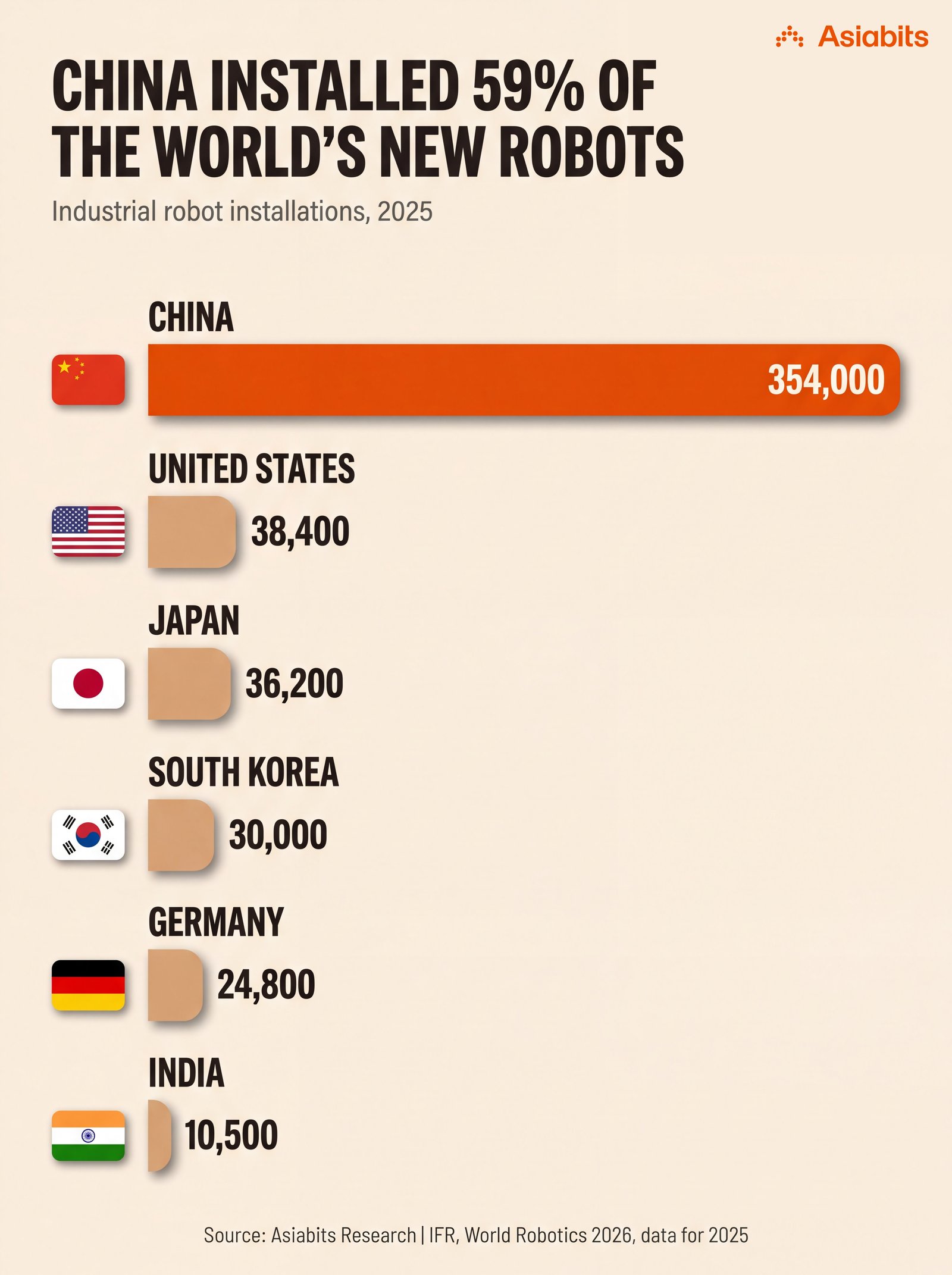
China is ahead in industrial robotics by a measure that matters: factories installed 354,000 industrial robots there in 2025, or 59 percent of all new installations worldwide. That shows a lead in deployment and market scale. It does not settle the broader question of whether China leads in every technology, from chips to software.
Where is China's technology lead easiest to measure?
Industrial robotics is a useful place to start because the numbers describe machines going into factories, not only announcements or investment plans. The International Federation of Robotics recorded 354,000 industrial robot installations in China in 2025, a 20 percent increase from the year before. Worldwide, factories installed 603,000 new robots. China therefore accounted for close to three in every five of them.
The count is about installations, which means robots newly put to work. It does not measure each machine's capability, the software running it, or the value it creates for the factory. Still, installations show that companies are purchasing automation at a scale no other national market currently matches. A technology becomes economically important when customers pay to put it into production and keep it running.
China's National Bureau of Statistics measures a different part of the system. It reported production of 773,074 industrial robots in 2025, up 28 percent year on year. Production and installation are not interchangeable: some units made in China can be exported, and factories can install robots produced elsewhere. Read together, the figures describe a large manufacturing base and a large domestic market, rather than a single measure of technological quality.
What does a large robotics market tell us about Chinese suppliers?
The strongest signal is the number of installations captured by manufacturers based in China. The IFR says Chinese robot makers installed 195,000 units in their home market in 2025, giving them a 55 percent domestic share. Their share was 57 percent in 2024. The 2025 figure is lower even as the number of units increased. Market share can fall while the underlying market expands.
These figures show local suppliers competing in a large domestic market. They give those companies a substantial customer base where they can build a track record, learn production requirements and improve products through repeated use. The figures do not tell us which individual products are better or cheaper than imported equivalents.
Industrial robots are also sold into several kinds of work. A factory may automate welding, packaging, material handling or precision assembly. Each task creates a different test of accuracy, speed, integration and maintenance. A supplier with a large home market can encounter more of those requirements and accumulate more chances to adjust its hardware and support model. This is an inference about the learning opportunities available to suppliers; the installation count does not measure whether they used them well.
At Asiabits, our robotics database tracks 7,321 companies. The total is a company count, not a ranking or a measure of sales. It helps put the robot figures into context: our records include makers, integrators, component suppliers and software companies. A country can develop industrial capability through the links among those firms, as well as through a few famous robot brands.
Why does deployment scale matter for innovation?
A new machine has to survive its working conditions. Factory operators care about whether it fits the line, how quickly it can be installed, what happens when a part fails and whether the production target improves. Every deployment is a chance to learn those details. The value of a large market is partly that more customers can test products in ordinary work, where small failures and awkward integrations become visible.
Scale does not automatically produce better engineering. It gives more opportunities to improve, and companies still have to use those opportunities well. They need reliable components, software engineers who understand the process, technicians who can diagnose faults and customers willing to report what broke. A robot count can measure adoption. It cannot show whether suppliers turned adoption into better products.
China's robotics lead also sits inside a manufacturing system that builds electronics, motors, sensors and machine tools at large scale. That gives robot companies nearby suppliers and potential customers. The installation figures establish that the market is large; the relationship between this market and the supply base is an explanation for how capability may develop. It should be treated as a mechanism to examine, rather than a conclusion guaranteed by the numbers.
That manufacturing connection is one reason robotics is a more revealing technology indicator than a single list of patents or startup valuations. It puts the technology under pressure from real users. The pressure can expose weaknesses quickly, especially when product cycles are short and customers have alternative suppliers. A market that buys at scale can reward practical improvements even when those improvements do not produce a dramatic research headline.
What does the Shenzhen experience look like to hardware founders?
When I spoke with Tuo Liu on the Asiabits Podcast, he described a founder pattern he had seen repeatedly: raise funding in the United States, build prototypes in Shenzhen, then sell products worldwide. Liu runs an open robotics community, and he told us that founders use it to find technical partners and suppliers. His account is a practitioner's view from a specific community, not a survey of every robotics startup in China. The full conversation with Tuo Liu is here.
The pattern helps explain why a location can matter even when the core technology was invented elsewhere. Prototyping depends on access to parts, engineering support and short feedback loops between a design and a physical object. A founder who can change a bracket, sensor mount or enclosure and test it quickly can learn sooner whether the product is viable. This is one route from design to a working product.
In our guide to robotics startups in Shenzhen, we map how companies and communities cluster across the city. And in our account of building hardware in Shenzhen, a founder describes how local suppliers help move a prototype toward production.
The location advantage also has limits. Teams still need a clear product specification, quality controls and someone who owns the engineering decisions. A dense supplier base does not remove the need to verify parts, protect intellectual property or qualify a production process. It makes certain work easier to do quickly, while leaving the founder responsible for whether the resulting product is sound.
Does this mean China is ahead in every technology?
No single indicator can answer that. Robot installations measure factory adoption. Production counts measure output. Neither is a substitute for comparing performance, cost over a machine's life, software capability, research quality or the control a supplier has over critical components. Those dimensions can point in different directions for different sectors.
The National Bureau of Statistics also reported that integrated circuit production rose 10.9 percent in 2025. That is useful as a production indicator. The table does not describe which process nodes were used, the yield of those chips or the performance of the most advanced products. More units produced can matter to the domestic supply base, but it does not establish that a country leads in semiconductor technology.
Technology leadership is better treated as a set of specific questions. Who can build a reliable product? Who can supply it at the volume customers need? Who controls the components and software that determine performance? How quickly can a company adapt when customers ask for changes? The answers differ between industrial robots, AI models, batteries, semiconductor equipment and other fields.
For industrial robotics, China has evidence of a clear lead in installations, alongside a large manufacturing base. Whether that lead translates into stronger products over the next decade will depend on reliability, productivity gains, overseas sales and the ability of domestic suppliers to keep improving. We need those results before turning a market lead into a sweeping claim about technological superiority.
What should a business learn from China's robotics lead?
First, separate market size from supplier quality. A large installed base is a reason to look closely at the companies serving it, not a guarantee that any one company will meet a buyer's requirements. Compare the exact application, safety needs, service coverage and references for the model under consideration.
Second, look at the surrounding supply chain. A robot's performance depends on its control system, sensors, actuators, tooling, integration and maintenance. A supplier map can help a team see which capabilities are concentrated in a city or industrial cluster and which may need to come from elsewhere. A useful question is where the technical decisions and production skills sit, along with where robots are assembled.
Third, talk to users and integrators. A short visit or technical discussion can reveal whether a product is already used for a similar task, how the installation is maintained and what changes the customer had to make. This is the ground-level evidence that a national statistic cannot supply.
I've lived in China for twelve years, and I have watched companies turn manufacturing access into a way to test and improve products. I'm Thomas Derksen, and my work at Asiabits focuses on helping international teams understand where robotics capability sits and how it connects to real suppliers. If you are mapping a robotics project, start with the Asiabits robotics supply-chain map.
Frequently asked questions
Is China ahead in technology?
China has a clear lead in industrial robot installations and a large production base. Those figures establish strength in manufacturing automation, while other fields such as semiconductors, software and AI need their own measures.
How many industrial robots did China install in 2025?
The International Federation of Robotics reported 354,000 new industrial robot installations in China in 2025, equal to 59 percent of worldwide installations.
How many industrial robots did China produce in 2025?
China's National Bureau of Statistics reported production of 773,074 industrial robots in 2025, up 28 percent from 2024. Production and installations measure different things.
Do China's robot numbers prove its robots are better?
No. Installation and production figures show scale and adoption. They do not directly measure reliability, productivity, software capability, lifetime cost or the quality of individual suppliers.
Why do hardware startups build prototypes in Shenzhen?
Founders cite access to suppliers, engineering support and faster prototyping. Those advantages can shorten product testing, but teams still need to verify quality, protect designs and qualify production.
Get These Insights Every Monday
Join 18,000+ professionals reading Asiabits. Free, every Monday, straight from Shanghai.
Subscribe Free →