Humanoid robots learn new tasks through methods including imitation learning from demonstrations and reinforcement learning through trial and feedback, often in simulation. Engineers then test the learned behaviour on the physical machine. The result depends on the training data, the robot's body and how closely the test conditions match the intended work.
Our notes from robotics visits in China put teleoperation in its own category, alongside models, computing and the robot body. Looking back at those visits, I find that separation useful: a person guiding a robot can be creating examples for future training. Understanding that process helps explain what a demonstration establishes and what work still lies ahead.
My name is Thomas Derksen, founder of Asiabits in Shanghai. For a team investigating Chinese humanoids, the training question is practical: how would this machine learn your task, and how would you know it had learned enough? The answer starts with a precise description of the work.
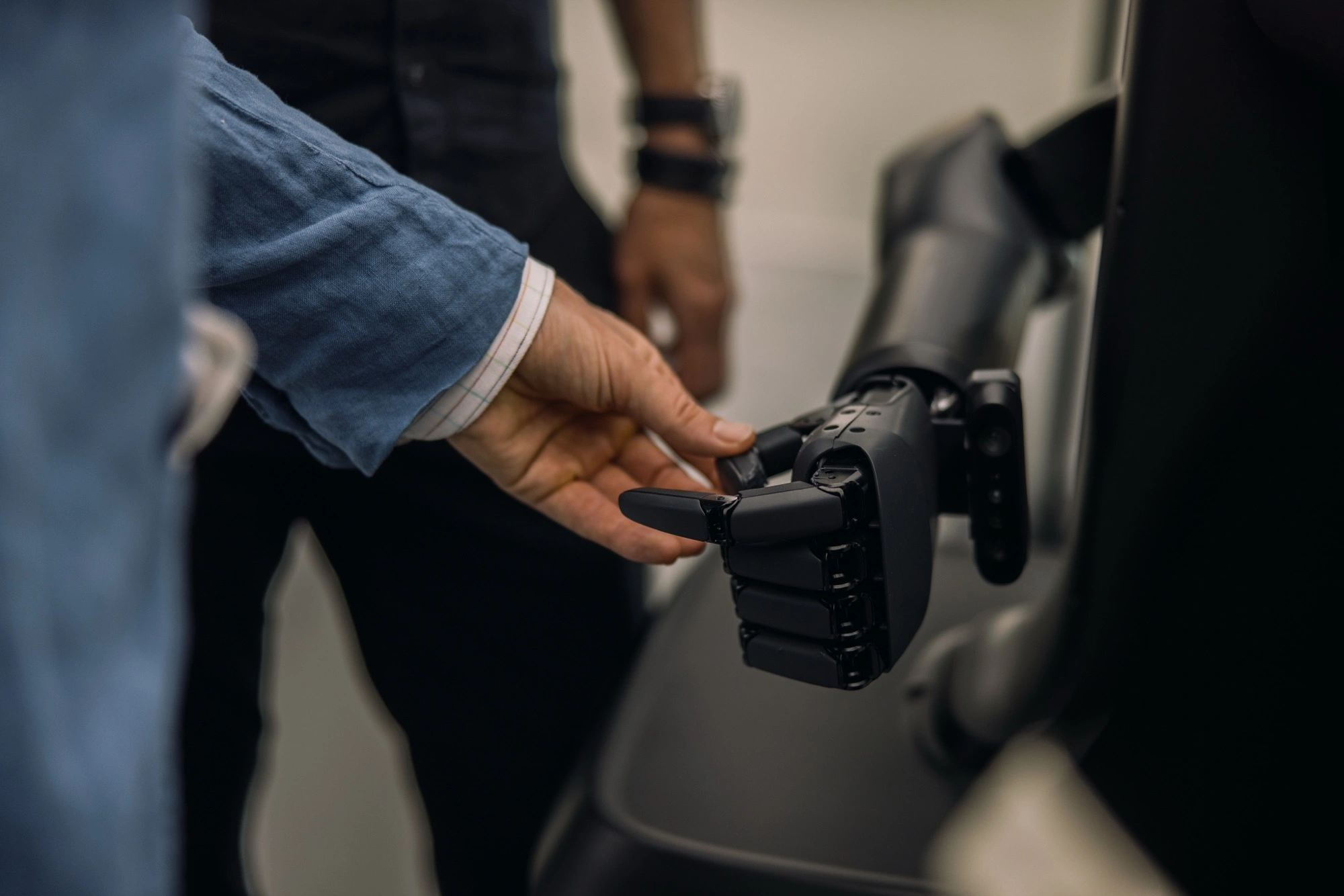
What does learning a robot task mean?
Learning a task means developing a policy that turns observations into actions which achieve an intended result. A policy is the part of the system that decides how the robot should act given the information available to it. That information might include camera images and the positions of its joints.
Consider an illustrative task: moving a part from a tray into a container. The robot needs to locate the part, reach it, establish a grip and release it in the right place. Success also needs a definition. A part that falls outside the container is a failed attempt, even if the arm followed an attractive trajectory.
The task description sets the boundaries of training. Specify the objects, starting positions and acceptable final state. Decide which variations belong in the intended application. A system trained with one rigid part on an empty table faces a different problem when parts overlap or the container moves.
A humanoid can combine several controllers or learned policies. Walking, balancing and manipulating an object are different capabilities, even when a video shows them together. Ask which capability a training result concerns. Our introduction to embodied AI explains how perception, computation and physical action fit together.
This also helps explain why a general instruction can require application work. The words describe the goal; engineers still have to establish how the robot receives observations, chooses actions and interacts with the objects involved.
How does a human demonstration become training data?
In imitation learning, demonstrations provide examples of actions associated with the observations a robot receives. Teleoperation lets a person guide the machine while the system records the interaction. Training uses those examples to learn a policy.
The Hugging Face LeRobot tutorial documents this sequence: collect demonstrations, train a policy and evaluate it on a robot. A leader arm or another control device can provide the human input. This is a documented workflow, with the hardware and task determining the actual setup.
A useful recording needs more than an attractive view of the finished action. LeRobot's dataset documentation describes a format combining video, sensorimotor signals and episode metadata. The relationship between what the system observes and the action taken is part of the training material.
For the tray example, plan demonstrations around the variation the robot will encounter. Keep track of the starting conditions and whether each attempt succeeded. Inspect recordings before training so that missing camera views, incorrect labels or a changed setup can be addressed. These are proposed preparation steps for that example.
The human role needs to be explicit during a live demonstration too. Ask whether an operator is controlling the current motion, recording examples or supervising a learned policy. All can be useful activities, but each answers a different question about the system. A clear explanation lets a visiting team understand the work it is seeing.
What can simulation teach a humanoid robot?
Simulation lets a robot policy be trained and tested in a modelled environment before physical deployment. In reinforcement learning, the policy is improved using feedback expressed through rewards. The training objective and the simulator determine which behaviours that process encourages.
Unitree's reinforcement learning repository documents a motion-control workflow that trains a policy, checks its behaviour, transfers it to another simulator and then deploys it on physical hardware. That is a specific example of the stages between learning in software and moving a real machine.
Unitree's separate MuJoCo simulator repository describes a development environment connected to its robot software tools. These resources give a technical team something inspectable: the supported platform, the controller interface and the route toward physical testing. They do not establish performance on an unrelated manipulation task.
For a proposed project, ask which parts of the task are represented in simulation. A walking exercise and a contact-rich grasping exercise involve different interactions. Find out which physical properties have to be modelled, how those assumptions are checked and what evidence the supplier has from the actual robot.
Simulation and physical demonstrations can contribute to the same development programme. The useful comparison concerns what each source of experience covers. A large quantity of simulated experience still leaves a practical question: does the resulting behaviour work with the objects, sensors and hardware intended for deployment?
Why does the robot's body change the training problem?
The body determines what the robot can observe and which actions it can carry out. Changing a gripper, camera position or joint arrangement changes some of the conditions under which a learned policy operates. Transfer to a new setup therefore needs evaluation.
Our visit framework treats the physical body as a separate engineering layer. Cameras, tactile information and actuators affect the interaction with an object. An instruction to grip gently has to become an action through those components. For a buyer, the relevant question is which configuration produced the demonstrated result.
In our database of 7,000+ robotics companies, the snapshot checked on 31 October 2026 contains 7,320 company records globally. The database separates humanoid robots, components and AI software into different categories. This is a research classification, useful for finding different kinds of partner; the record count measures our coverage.
That distinction appeared in our January 2026 robotics analysis too. A robot manufacturer, a sensor developer and a software team may contribute to one application through different responsibilities. For a training project, identify who supplies the machine, who adapts the policy and who measures the result. The name on the robot may answer only part of that question.
Keep a configuration record for the evaluation: machine, gripper, sensors, software and physical setup. When something changes, decide what must be tested again. Our guide to Unitree robot control gives further context on the distinction between a hardware platform and the software controlling it.
How do you test whether a robot has learned the task?
Test a fixed policy on agreed conditions and record complete attempts, including failures and human intervention. The evaluation should describe the work the robot can perform within those conditions. Keep training examples and evaluation cases identifiable so that the results can be interpreted.
For the tray example, define a successful placement before running the test. Record the starting arrangement, the outcome and any assistance. Include attempts in which the object slips or the robot stops. A result with the number of successes and total attempts is easier to assess than an edited sequence of successful movements.
Then introduce the variation that matters to the application. Try the intended range of object positions, lighting conditions and container placement. Agree on that test envelope with the technical team. The purpose is to understand the boundary of the skill and identify where additional training or engineering is needed.
Measure recovery as well as the main action. Who resets the workstation after a failed grasp? Can the policy try again, or does a person need to intervene? Record time spent on those activities separately so that the operating team can assess the whole process. A useful test makes the support effort visible.
Learning one task under agreed conditions leaves other questions open, including long-term reliability and suitability for the intended workplace. These require their own evidence. Our pre-pilot supplier guide helps connect the technical result with a decision about the next stage.
What should a team prepare before asking for robot training?
Prepare a task brief, representative objects and a proposed evaluation method. These give a supplier enough information to explain its training approach and the work required. Start with the process you want to improve, including how it is performed today.
The brief should describe the starting state and required outcome, relevant object variation and physical restrictions. Identify the information you can share for feasibility assessment. Before recording at a workplace, agree on permissions, storage and access for the resulting material, especially where people or proprietary processes could appear.
Ask the supplier to distinguish existing capability from adaptation work. Which policy and hardware are available now? What demonstrations would be collected for this application? Who would carry out training and evaluation? The answers provide a basis for a scoped technical discussion without assuming a universal training duration.
A visit can help you understand that process by bringing the relevant engineers and equipment into the same discussion. Request an explanation of a complete training cycle and a demonstration of the resulting skill under stated conditions. Leave with the configuration, test results and the unresolved questions assigned to someone who can answer them.
Asiabits organises robotics visits in China around the decision a team needs to make. We research suitable companies, coordinate meetings and help visitors discuss their application with hosts. Bring the task you want a robot to learn; that determines which hardware, software and application specialists belong in the programme.
Frequently asked questions
Do humanoid robots learn by watching people?
Some robot learning workflows use human demonstrations. Teleoperation can record the robot's observations and actions while a person guides it through a task. Training then uses those examples to learn a policy, whose performance still needs evaluation.
What is the difference between imitation learning and reinforcement learning?
Imitation learning uses demonstrations as examples of behaviour. Reinforcement learning improves a policy through feedback expressed as rewards during interaction with an environment. A development programme can use multiple methods for different capabilities.
Can a humanoid learn entirely in simulation?
Simulation can support training, including motion control, as Unitree's public workflow illustrates. Physical evaluation is still needed to establish how a resulting policy behaves on the intended machine. A simulated result alone cannot establish performance on a customer's task.
How long does it take to teach a humanoid a new task?
There is no universal duration supported by the material reviewed here. It depends on the task, existing policy, hardware, available data and required performance. Ask for an adaptation plan and an agreed evaluation method for the specific application.
Does changing a robot gripper require new training?
A different gripper changes the physical setup, so transfer needs evaluation. The technical team should determine whether the policy works with the new configuration or needs adaptation. Record which configuration produced each test result.
Get These Insights Every Monday
Join 18,000+ professionals reading Asiabits. Free, every Monday, straight from Shanghai.
Subscribe Free →