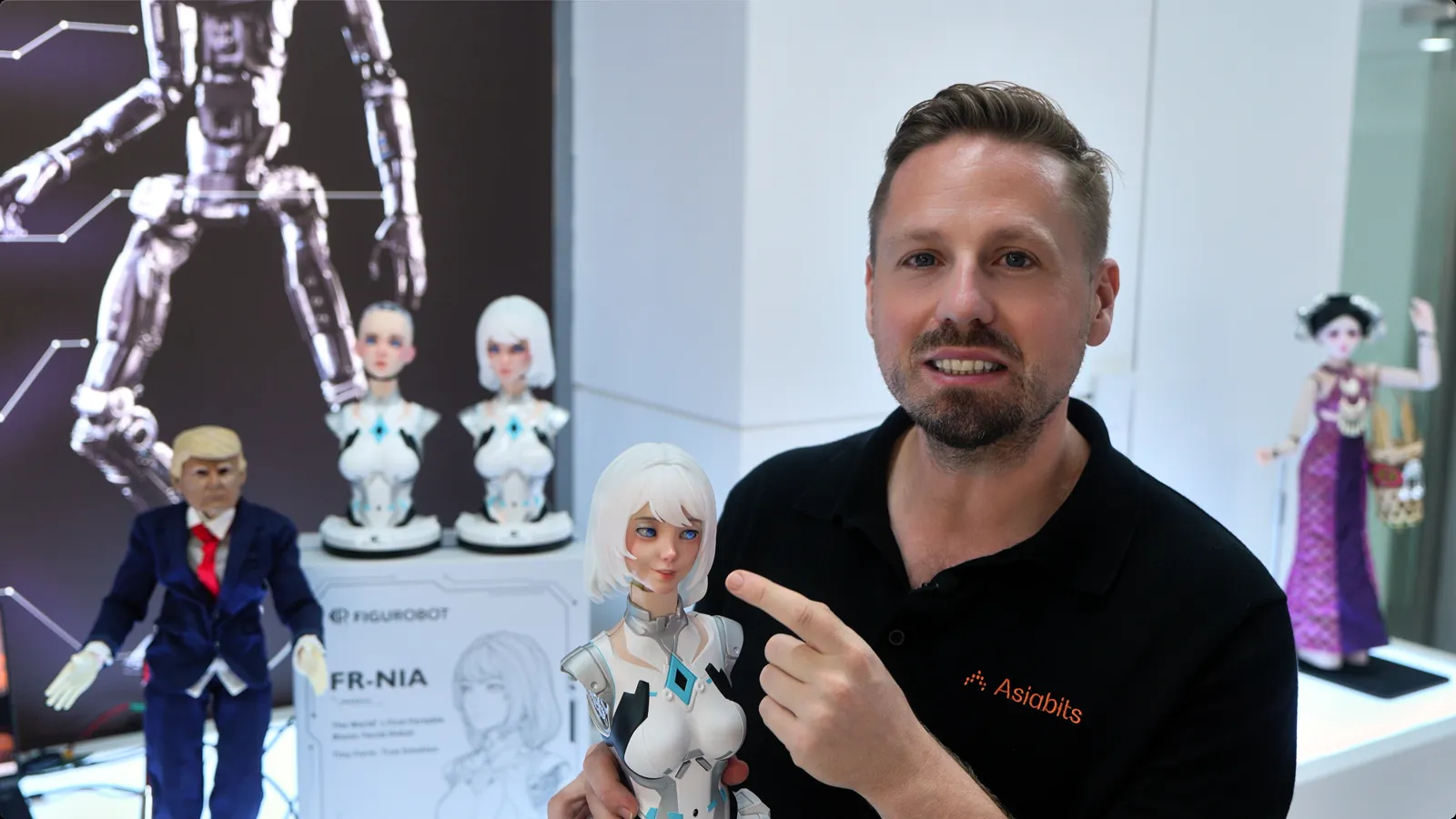
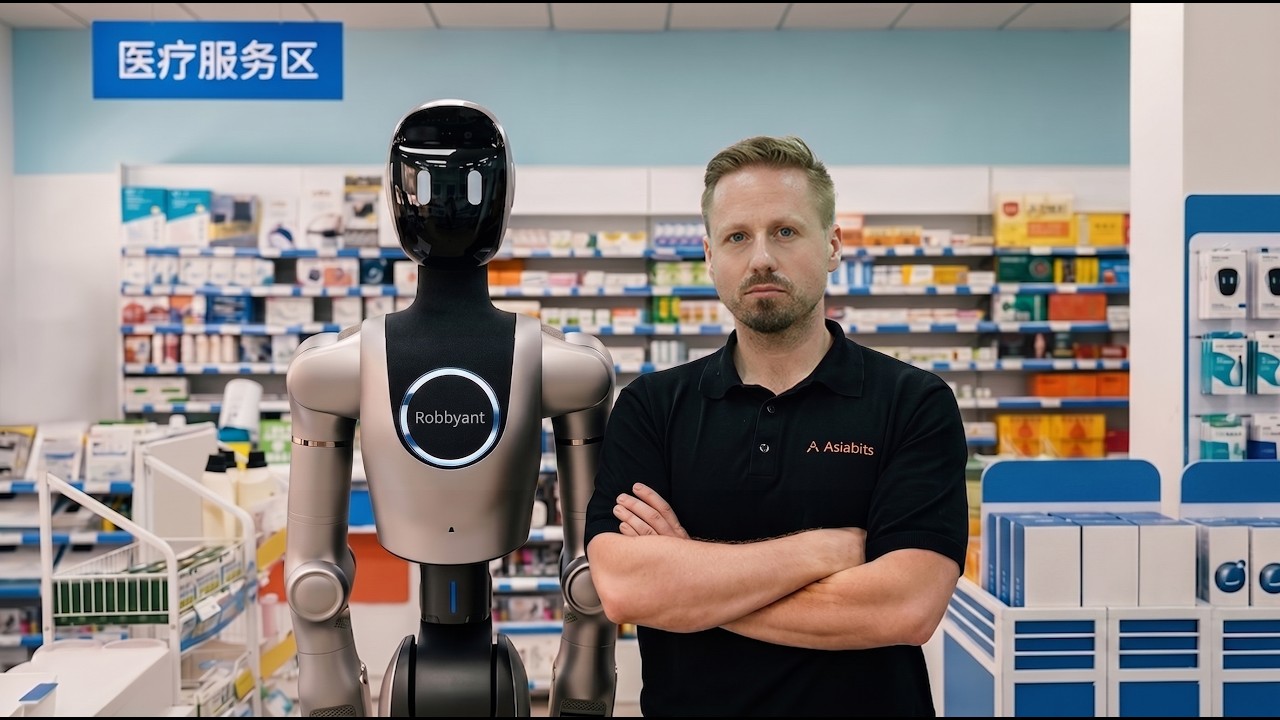
Embodied AI is artificial intelligence that learns or acts through a physical system, such as a robot arm, mobile robot or humanoid. In China, understanding it means examining the complete system: the model, its training data, the computing hardware and the body. Commercial usefulness depends on how those parts perform together on a real task.
I first met Francesco Crivelli on a flight from Shanghai to Shenzhen. He was so absorbed in coding that, after being asked to close his laptop, he lowered the screen and kept typing. When we later sat down for the Asiabits Podcast, our conversation moved from that encounter to a much harder question: why is deploying a robot still so difficult?
His answer was about integration. A model can be promising and a robot can be impressive, yet putting them together in a customer's operation remains substantial engineering work. That conversation is a useful starting point for anyone trying to understand China's embodied AI industry beyond a product launch.

I'm Thomas Derksen, founder of Asiabits in Shanghai. During robotics visits in China, I have found it useful to separate a company's capabilities into layers. It makes discussions with engineers more precise and helps visiting business leaders work out where they could participate.
What does embodied AI mean in practical terms?
Embodied AI connects perception and decision-making to physical action. The system receives information about its surroundings, chooses an action and encounters the consequences of that action through its body.
Consider a robot picking a component from a tray. It needs to locate the part, approach it, make contact, grip it and place it correctly. Each step depends on the previous one. A small error in perception can become an awkward grasp; an awkward grasp can become a dropped part.
A language model may help interpret an instruction. A robot policy determines actions. Sensors provide observations, and actuators turn commands into movement. The useful question for a buyer is which of these functions the supplier has demonstrated under the conditions the buyer needs.
A humanoid is one possible body. An arm fixed to a workbench can also be part of an embodied AI system. Choosing the body should follow the task. If the work happens in a fixed position, the ability to walk may contribute little while adding engineering demands.
This distinction matters when people discuss China as though every new humanoid were the same kind of business. Some teams develop models, some build machines, and some integrate a system for a particular application. Their demonstrations may look similar while their responsibilities differ substantially.
How should you assess China's embodied AI companies?
Start with four connected layers: models, computing, training data and the physical robot. This framework comes from our own robotics visits and discussions with manufacturers in China.
The model layer includes the software that interprets observations and produces useful decisions or actions. When a supplier describes a foundation model, ask which tasks it supports and what changes when it is connected to a different machine. A model's performance has to be understood together with the hardware and evaluation conditions.
The computing layer includes the equipment used for training and the equipment running the system during operation. These are different requirements. A robot may need to respond locally even when training happens elsewhere. For a pilot, establish where inference runs and what happens if connectivity is interrupted.
The data layer contains examples of the interaction the robot needs to learn. Camera footage alone may omit the action commands and physical state needed to understand a demonstration. The relationship between observations and actions is central to training a system that can reproduce useful behaviour.
The body includes cameras, force sensors, joints, grippers and the mechanical structure. Heat and weight also belong in the discussion. A model cannot compensate indefinitely for missing information, an unsuitable gripper or hardware that cannot sustain the required operation.
For a European component supplier, this creates a practical way to identify opportunities. Ask where your product improves the complete system: better measurement at contact, more reliable movement, reduced heat or simpler integration. You can have a relevant role without building a complete humanoid.
Why does robot training need physical demonstrations?
Physical demonstrations show how observations correspond to actions on a particular task and machine. They provide a route from a description of work to examples the robot can learn from.
Teleoperation is one way to collect those examples. A person controls the robot while the system records what the robot sees and how it moves. In our visit notes, this data-collection process sits alongside models and hardware as a separate part of the development effort.
The public LeRobot documentation from Hugging Face illustrates the sequence: teleoperate a robot, record demonstrations, train a policy and deploy it. Its dataset format combines video with action and state information. That makes the relationship between the demonstration and the resulting behaviour easier to understand.
For a business team, the implication is that access to a model is only one input. Your objects, workstation and robot configuration still matter. A supplier should explain which existing training data is relevant and where new demonstrations would be required.
Imagine a proposed task involving flexible packaging. The evaluation should include the actual packaging and the variation expected in use. A neat presentation with a rigid object would answer a different question. This is an illustrative test design, rather than a claim about any specific supplier's performance.
Data rights also deserve a practical discussion before collecting demonstrations. Establish who can access the recordings, where they are stored and whether they can be reused for other deployments. Those decisions affect how easily the pilot can be repeated or transferred to another site.
Why can an impressive demonstration still be hard to deploy?
A demonstration proves a result within its demonstrated conditions. Deployment requires the system to handle the operating conditions, interruptions and recovery procedures of the customer's process.
In our podcast conversation with Francesco Crivelli, he discussed semi-autonomy, the difficulty of longer tasks and the limitations of some inexpensive robot hardware for continuous operation. These were his observations during the recording, rather than a statement that every robot today has the same limits.
That distinction helps keep an evaluation honest. Ask a team to describe the boundary of its demonstrated capability. If a person intervenes, find out what triggers the intervention and what the person does. An explicit human role can be a workable operating design when its cost and availability are understood.
For a pilot, define the beginning and end of a successful cycle. Record failures as well as successes. Include the time spent resetting objects, changing consumables and recovering from errors. Otherwise the attractive part of the video can hide much of the work needed to keep the system running.
Run the evaluation with representative variation. Change the starting position within the intended operating envelope. Use the objects the system will encounter. Have the operating team observe what happens after a failed attempt. These steps produce evidence that is more useful for a purchase decision than another edited demonstration.
Our guide to vetting a robotics supplier before a pilot develops the supplier side of this process. For embodied AI, the extra question is how model behaviour and physical limitations interact when the task becomes less predictable.
Which applications should a business examine first?
Begin with an application where the task, environment and value of a successful outcome can be defined clearly. That gives both the buyer and the development team a basis for evaluating progress.
In an August LinkedIn post, I described seeing cleaning and delivery robots regularly in Chinese malls, hotels and hospitals. The observation was about familiarity: people often walked past them without paying attention. A machine can become ordinary in a particular setting while another type of robot remains a research or pilot proposition.
That is why I separate an immediate operating decision from a longer-term technology investigation. A team seeking a near-term improvement should compare the proposed system with the established ways of doing the task. A team exploring a future product may accept a different level of uncertainty, provided it has a clear learning objective.
For example, a component manufacturer might investigate how its sensing technology affects grasp quality. The first useful outcome could be a measured improvement on a test setup. That is a different project from buying a machine to take responsibility for a production station.
China offers opportunities to investigate both questions through direct conversations with hardware and software teams. In our podcast, Francesco described the benefits of proximity when developing hardware and working with manufacturers. His account is a founder's experience; it should help shape questions for a visit rather than replace checking a specific partner.
When selecting whom to meet, match the visit to the decision. A model team can explain its training approach. A hardware manufacturer can discuss its machine. An integrator can explain the work of fitting a system into a process. Our guide to choosing a Chinese robotics company provides a starting point for that selection.
What should you take away from a China embodied AI visit?
Leave with a clear account of what the system can do, what remains to be tested and who would carry out the next piece of work. Those answers turn a visit into a useful commercial or technical decision.
I would ask the team to show the task under agreed conditions, explain the role of human intervention and describe the data needed for adaptation. Then I would ask the prospective operating team to identify the conditions the demonstration did not cover. The gap between those two descriptions is the scope of the next evaluation.
We cannot infer broad reliability from a single visit, nor can a general article establish that a particular model will work on your production line. The framework here helps structure the investigation. Performance still needs to be measured on the intended task.
At Asiabits, we help international teams identify relevant robotics and AI companies in China and organise visits around their actual questions. If you are evaluating a supplier partnership, a component opportunity or a pilot, tell us what decision the visit needs to support. We can build the programme around the people and demonstrations needed to answer it.
Frequently asked questions
Is embodied AI the same as a humanoid robot?
A humanoid is one possible body for an embodied AI system. Robot arms and mobile robots can also connect perception and decision-making to physical action.
What are the main parts of an embodied AI system?
A useful assessment separates models, computing hardware, training data and the physical body. Their interaction determines performance on the intended task.
Why is teleoperation used in robot training?
Teleoperation allows a person to demonstrate a task while the system records observations and actions. Those demonstrations can be used to train a robot policy.
How should a company evaluate a Chinese embodied AI supplier?
Define a representative task and test conditions, then observe complete cycles including failures and recovery. Establish the human role and the adaptation work needed before judging commercial suitability.
Can a demonstration prove a robot is ready for production?
A demonstration provides evidence within its demonstrated conditions. Production suitability requires evaluation against the actual operating environment, expected variation and support requirements.
Get These Insights Every Monday
Join 18,000+ professionals reading Asiabits. Free, every Monday, straight from Shanghai.
Subscribe Free →