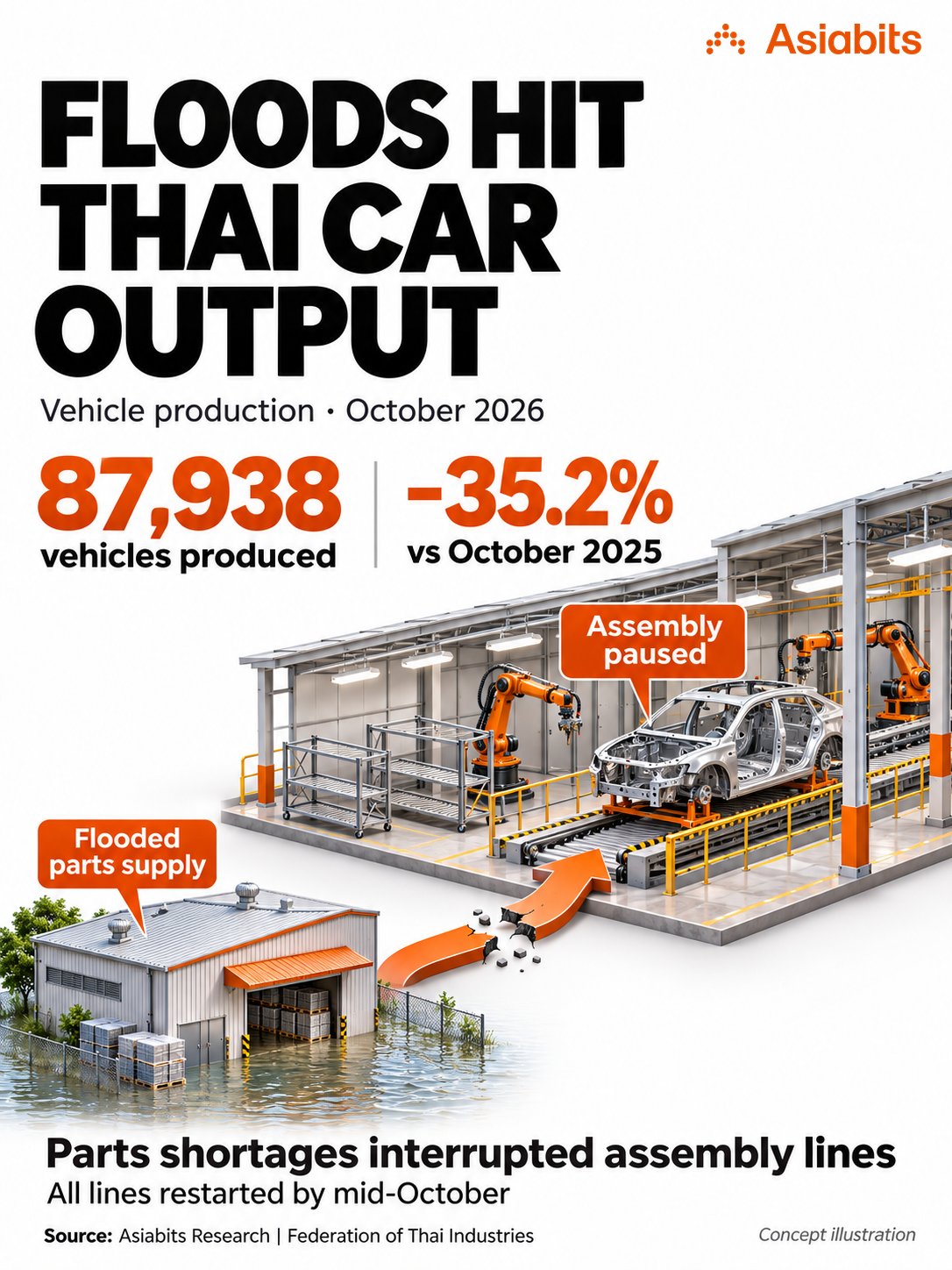
Thailand’s factories produced 87,938 vehicles in October 2026, 35.19% fewer than a year earlier. The Federation of Thai Industries links the fall to floods that disrupted parts deliveries and kept some employees from reaching work.
A supplier interruption reached the assembly line
The federation describes disruption from late September to mid-October. Several manufacturers temporarily stopped assembly because suppliers could not deliver components. All factories’ production lines had resumed by mid-October, but the lost production still affected the monthly result.
The graphic rounds the annual decline to 35.2%. In index terms, October 2025 equals 100 and October 2026 equals 64.81: 100 − 35.19. The vehicle count is the federation’s reported total for October 2026.
The total hid very different product trends
| October 2026 measure | Vehicles | Change from a year earlier |
|---|---|---|
| Total vehicle production | 87,938 | −35.19% |
| Battery-electric cars | 14,104 | +50.15% |
| Combustion pickups | 41,829 | −30.45% |
| Total vehicle exports | 54,503 | −34.38% |
Battery-electric passenger-car output rose even as overall production fell. That difference matters for suppliers: exposure to the Thai automotive market depends on the vehicle category and customer programme, as well as the national total.
Follow the component path
Asiabits’ practical reading: resilience checks should follow the parts needed to finish a vehicle. A working assembly plant still needs components, transport routes and workers to arrive together. For sourcing teams, map the critical supplier locations, alternative delivery routes and the parts whose absence would stop final assembly. The Thai case provides a concrete reason to test that chain before a disruption.
Get These Insights Every Monday
Join 18,000+ professionals reading Asiabits. Free, every Monday, straight from Shanghai.
Subscribe Free →