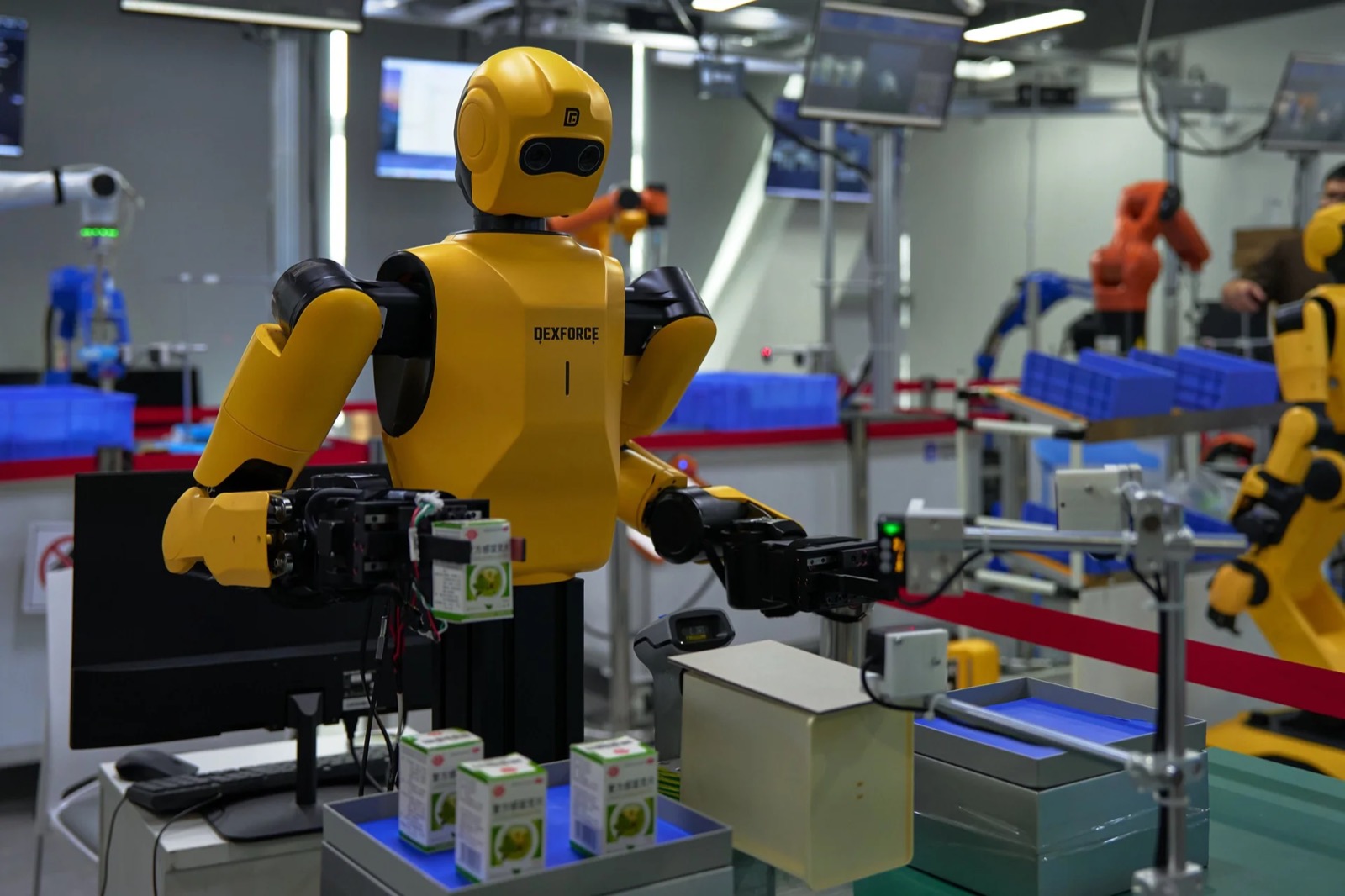
China leads the world in industrial robot installations, with 59% of the global total in 2025. For humanoids, the useful comparison is task performance: what a machine can repeat, how much human help it needs, and what it costs to operate. Buyers should assess factory automation and humanoid development separately.
During a visit to a robot maker in Shenzhen, an engineer put a robot hand in my palm. In my July 2026 LinkedIn post about that visit, I described how much attention the hand demanded before we even reached the rest of the machine. That small component is a good place to start understanding China's robotics industry.
I'm Thomas Derksen, founder of Asiabits in Shanghai. When I look at robotics here, I want to understand both the finished machine and the companies building its parts. A national installation total answers one question. A working hand, a repeatable task and a service team answer several different ones.

Where does China lead in robotics today?
China's clearest measurable lead is the scale of its industrial robot market. The International Federation of Robotics' World Robotics 2026 release reports 354,000 installations in China in 2025, representing 59% of the worldwide total. Those are new industrial robot installations during one year.
Chinese manufacturers supplied 195,000 of those installations, or 55% of their home market, according to the same release. This separates two useful measures: where robots are installed and who supplies them. A robot installed in China can come from a Chinese manufacturer or a foreign one. The market's size and domestic suppliers' share describe different opportunities.
For a manufacturing executive, that scale makes China an important place to investigate automation suppliers and applications. For a component maker, the question becomes which manufacturers need a particular drive, sensor, connector or gripper. For a buyer seeking a production system, the question is which supplier can deliver the process required at the intended site.
Keep the comparison attached to the work. If your process involves placing a rigid part into a fixed fixture, ask suppliers to demonstrate that operation with your tolerances. If the task involves mixed objects arriving unpredictably, ask for that variation. A national ranking helps decide where to look; a process test helps decide what to buy.
Does industrial robot leadership mean humanoid leadership?
Industrial installation figures cannot rank humanoids by autonomy, dexterity or commercial usefulness. A factory arm executing a defined motion and a humanoid handling changing objects face different engineering demands. Put them in the same presentation without separating their jobs and the investment discussion quickly becomes confused.
A humanoid buyer needs evidence about the complete sequence. Can the robot identify the object, reach it, grip it, move it and release it correctly? Can it handle the next object when its position changes? What happens when the grip fails? Each question adds an operating condition to a demonstration that may otherwise look straightforward.
Oliver Hsu's January 2026 analysis of the physical AI deployment gap describes the distance between robot-learning demonstrations and production systems. He identifies changing environments and human support as practical obstacles. For buyers, the implication is to request evidence from a complete task in the environment where it must work.
Take a hypothetical packing operation. A successful run might begin with a part presented in a known position and end with it placed in a box. An operational assessment would also count misplaced parts, retries, operator resets and damaged packaging. Agree on what counts as success before watching the demonstration, so everyone measures the same outcome.
Our guide to comparing advanced humanoid robots in China goes further into that task-based assessment. The useful result is a shortlist tied to a job and a set of test conditions.
What does the supplier base reveal beyond the big robot brands?
The supplier base shows how much of robotics sits outside the finished robot. In our database of 7,000+ robotics companies, a 3 November 2026 snapshot contains 7,320 company records. The largest category is Components, with 1,597 records; Humanoid Robots contains 214. These are categories in the Asiabits research database, covering multiple countries.
That balance matters when planning research. A search limited to humanoid brands would miss many companies making the parts those machines require. It would also miss businesses working on established automation applications that may fit a buyer's immediate production problem.
The hand I held in Shenzhen made the component question tangible. Its size tells you little about the work behind the mechanism. A useful supplier conversation asks about grip force, repeatability, wear, replacement and control interfaces. Those details determine how the hand can be used and supported inside a larger system.
For a European component supplier exploring China, begin with the function you can improve. Explain the load, temperature, precision or lifetime your product can support, then identify robot makers with a matching requirement. A broad statement about serving humanoids gives a potential partner much less to evaluate than a defined component and an application.
For buyers, use the same approach in reverse. Ask which parts can be replaced locally and who diagnoses a failure. Find out whether a component change requires software changes or recalibration. A clear answer makes the supplier easier to compare and gives your maintenance team something concrete to assess.
How should buyers compare Chinese robotics companies?
Compare companies against a written task brief and a shared test, then examine the support required to keep the result repeatable. A short brief can identify the object, starting position, destination, required output and operating environment. Include the variations that your team already encounters in daily production.
Define the output in terms your production team already uses. For handling, that might be correctly placed parts per hour; for inspection, it might include accepted defects and false rejects. Choose the measure before comparing equipment, so a faster demonstration cannot obscure a poorer result.
Send the same brief to each candidate. Ask what can be demonstrated with current equipment, what requires engineering and what information the supplier needs from you. This makes the first meeting productive: both sides can discuss an actual process rather than exchange general product presentations.
During the test, record total attempts and successful completions. Separate autonomous actions from remote operation and manual resets. Include the time taken to restore the machine after an interruption. These measurements let your team compare useful output over the full test period.
Then review integration. Someone must connect the robot to its surroundings, manage signals, arrange the work area and define safe operating procedures. Ask the manufacturer which work it performs itself and which work belongs to an integrator. Assign one responsible party to each interface before proceeding with a pilot.
Finally, discuss support at the destination. Identify who supplies spare parts, who can access diagnostic data and how the local team receives training. For a company buying across borders, these details belong in supplier selection. They affect the engineering effort needed after the machine arrives.
The Asiabits humanoid company selection guide offers a starting point for researching manufacturers. Use it alongside the task brief, then narrow the field through direct technical conversations.
What should a robotics visit in China help you decide?
A useful robotics visit should help you decide which application to investigate, which supplier to test and what evidence your team still needs. Plan around those decisions. Seeing a component supplier and a robot manufacturer can answer different parts of the same operating question.
For example, a team investigating handling could examine the end effector, watch the complete pick-and-place sequence and discuss the integration work around it. That sequence connects a component's specification to a process. It also gives different members of the visiting team a shared reference for their follow-up questions.
Bring the people who will judge the result. An operations colleague can explain the variation in incoming materials. A controls engineer can assess interfaces. A maintenance colleague can ask how to recover the system. Where a full team cannot travel, collect their questions and arrange a technical follow-up with the supplier.
Allow time to observe repeated operation. A short demonstration can establish what the machine is intended to do; a longer technical discussion should establish the conditions behind it. Ask to see how the operator starts the task and handles an interruption. Those moments often generate the most useful questions for a pilot.
Close each meeting with a specific next step: a sample to send, a test protocol to agree or a technical document to review. Record who owns that step. The visit then produces a comparison your colleagues can use when discussing engineering resources and a potential purchase.
China's industrial installation lead makes its robotics sector worth serious attention. The opportunity for your company becomes clearer when you connect that scale to a particular task, component or supplier relationship. Start with the work you want to improve, and use the visit to gather the evidence needed for the next decision.
Asiabits helps international teams research robotics companies and prepare focused conversations in China. Our robotics directory supports initial research, while Bespoke Tours bring teams into relevant companies for demonstrations and technical discussions. Share the application you are investigating so the programme can focus on the questions your team needs answered.
Frequently asked questions
Is China leading the world in robotics?
China leads in annual industrial robot installations, accounting for 59% of the worldwide total in 2025 according to IFR. Assess humanoid performance separately against a defined task and operating conditions.
Does China's robot installation total measure humanoid sales?
The cited IFR figure measures industrial robot installations. It does not provide a humanoid performance ranking or a count of autonomous humanoids working full shifts.
How can a buyer assess a Chinese humanoid robot?
Use the same task brief for each supplier and count attempts, successful completions and human interventions. Review integration, fault recovery and destination support before committing to a pilot.
Why research robotics component suppliers in China?
Components affect the performance and maintainability of a complete robot. Compare relevant specifications, replacement options and control interfaces alongside the finished machine.
Get These Insights Every Monday
Join 18,000+ professionals reading Asiabits. Free, every Monday, straight from Shanghai.
Subscribe Free →