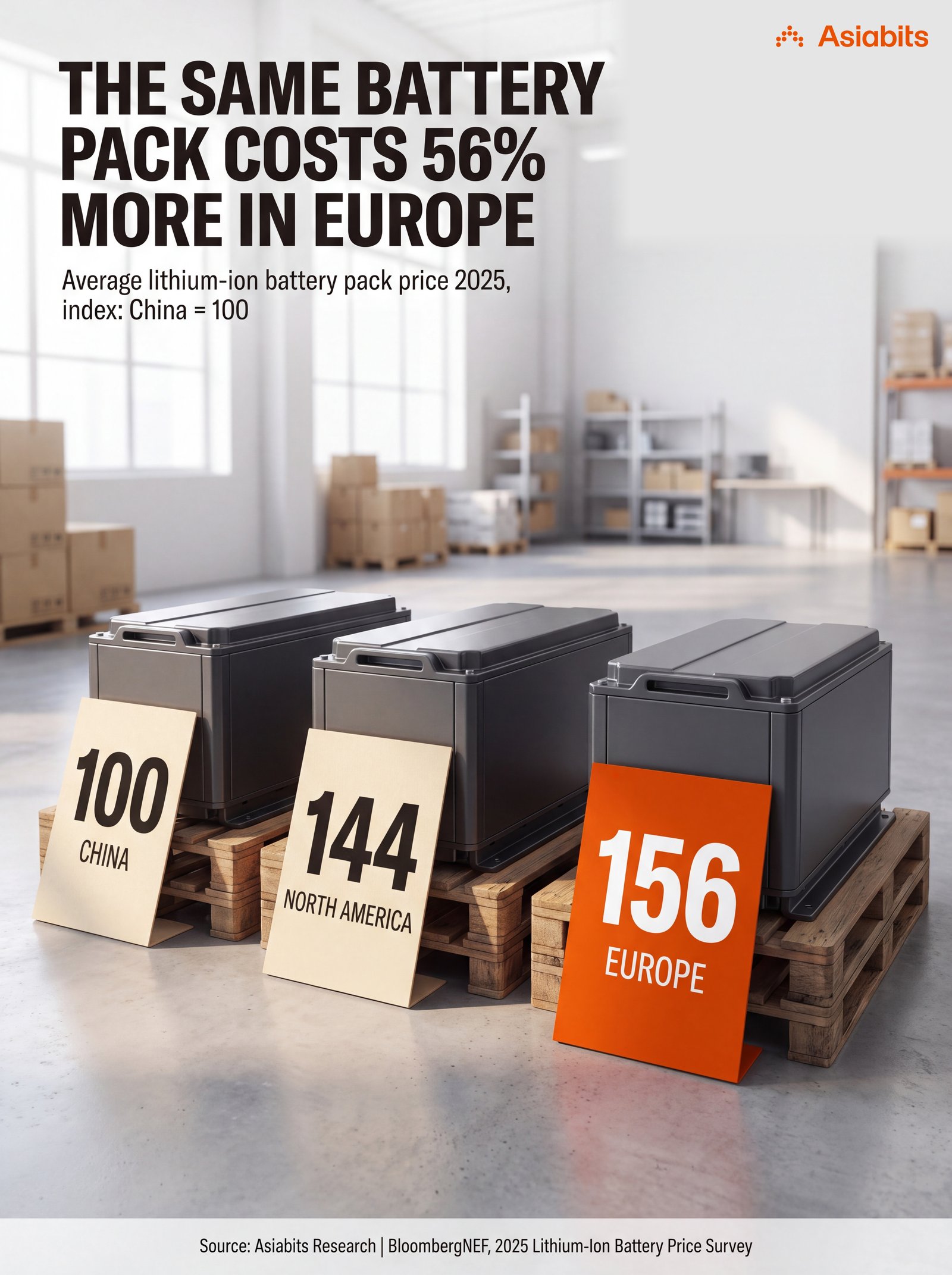
China's battery packs cost less because makers combine deep supply chains, large factories, fierce competition and a product mix weighted toward lower-cost chemistries. BloombergNEF put the 2025 average at $84 per kilowatt-hour in China, while Europe's average was 56% higher. That regional average is a useful signal for European buyers, though it does not compare identical packs.
In a conversation on the Asiabits podcast, I asked Joshua Woodard about the manufacturing network he saw while working with factories in Shenzhen and Dongguan. He described display, battery, chip and circuit-board suppliers operating close enough to share workers and production know-how. That picture helps explain why a price gap can persist even when wages are only one line in the cost sheet.
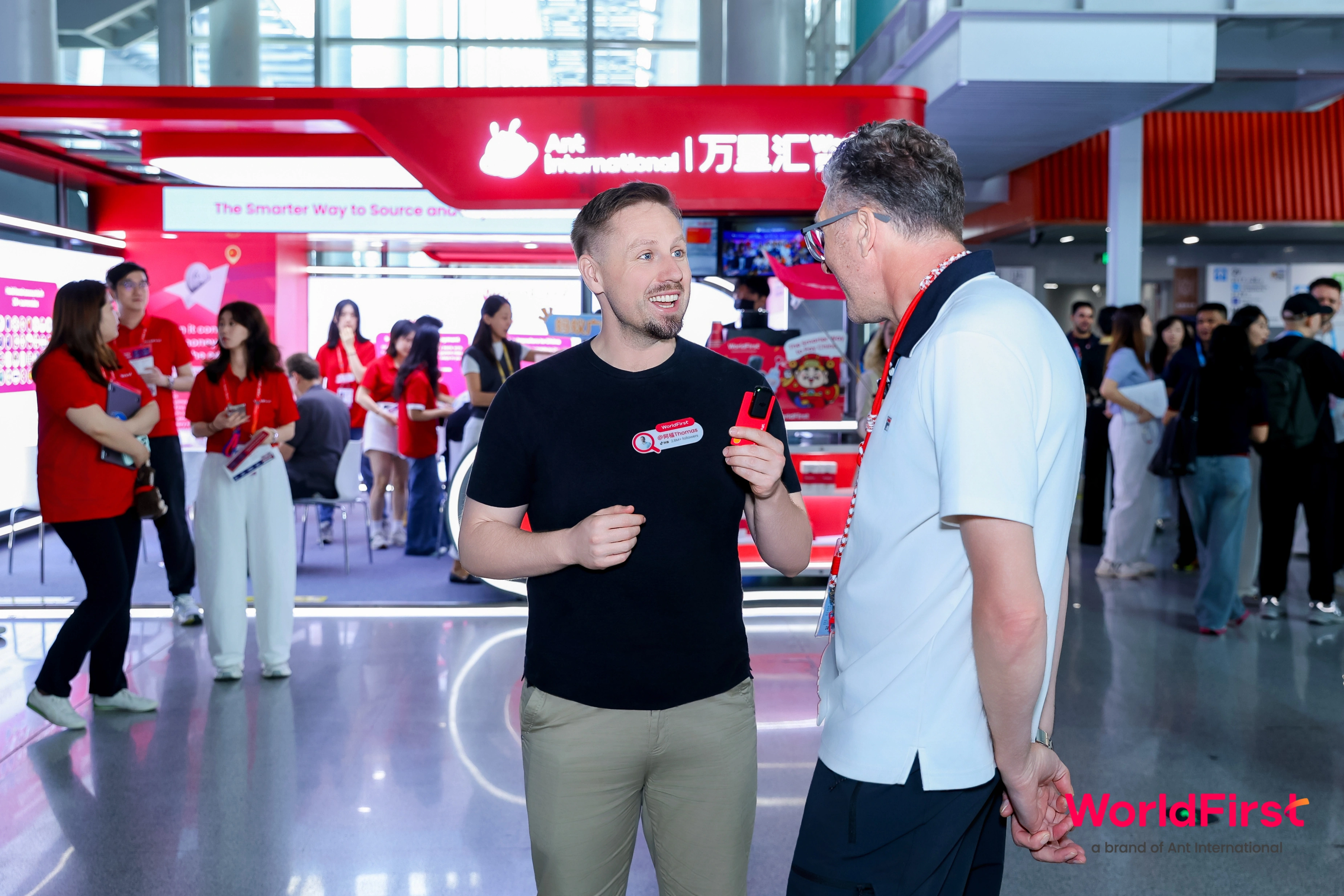
I'm Thomas Derksen. I've lived in China for twelve years, and I spend much of my work connecting European companies with Chinese manufacturers. The useful question for a purchasing team is how much of the price gap comes from structural advantages, how much comes from market pressure, and which part will remain after a tariff, shipping cost or product specification changes.
How large is the China-Europe battery price gap?
BloombergNEF's 2025 survey found an average lithium-ion pack price of $84 per kilowatt-hour in China. It reported European prices 56% above that level, which implies roughly $131 per kilowatt-hour for the regional average. The overall global average was $108. These figures cover packs for different uses, including electric vehicles and stationary storage. They describe market averages, not a controlled comparison between two identical packs bought under the same contract.
The distinction matters for a buyer. Battery prices vary by chemistry, application, size, safety requirements, service life and contract terms. A grid-storage pack designed for stationary use is not interchangeable with a pack engineered for a vehicle. BloombergNEF reported that 2025 average prices also differed by chemistry: $81 per kilowatt-hour for LFP packs across segments and $128 for nickel-manganese-cobalt packs. Product mix alone can move an average.
Still, a persistent regional price gap is commercially relevant. European manufacturers competing on vehicle or storage-system costs need to know whether their supplier quotes reflect a different product, a different contract or a more expensive production base. The gap gives a starting point for that discussion. It does not tell a procurement team what a particular pack should cost.
Germany's exposure is direct. Destatis reported that China was Germany's largest trading partner again in 2025, with goods trade totaling €251.8 billion. That total spans many sectors, including areas beyond batteries. It shows why cost and supply decisions cannot be separated from trade relations. A German company may buy components from China, sell equipment into China, or face Chinese products in third markets.
What makes Chinese battery production cheaper?
Several forces stack together. China has a large base of cell and pack production, suppliers that serve overlapping customers, and a mature network for materials and components. Factories can draw on engineers and process knowledge already concentrated around their industrial customers. This reduces the time and coordination cost of solving production problems, even when wages are rising.
On episode 12 of the Asiabits podcast, Joshua Woodard described Guangdong's consumer-electronics network from his experience managing camera production at Apple suppliers. He noted that factories making displays, batteries, integrated circuits and printed circuit boards sit close together. Teams encounter similar problems repeatedly, and practical knowledge moves between nearby production lines. His account is a grounded example from electronics manufacturing. It should not be generalized to every battery plant or industrial product.
Scale also matters through utilization. A factory's equipment, buildings and engineering teams keep costing money whether its lines are full or idle. High output spreads those costs across more units. When capacity exceeds demand, however, suppliers may cut prices to keep lines running. The same capacity that supports low unit costs can create pressure to sell at thin margins.
Chemistry has changed the equation too. BloombergNEF attributes lower battery prices to a combination of manufacturing overcapacity, intense competition and greater use of lithium iron phosphate, or LFP. China has a strong position in LFP production, and BNEF says Chinese output can meet nearly all global demand for that chemistry. Buyers should compare the chemistry and performance specification before treating one quotation as a direct benchmark for another.
Automation contributes, but a robot does not make production cheap by itself. It requires capital, maintenance, integration and enough stable volume to justify the investment. In Asiabits' database of more than 7,000 robotics companies, we track the businesses supplying and using automation across China and other markets. That map helps us identify where industrial capability is concentrated. It does not provide a battery cost index or prove that a specific factory is efficient.
Does low-cost production come from low wages?
Labour is one input. A buyer who attributes the full gap to wages will miss the parts that are harder to move: supplier density, process experience, factory utilization, financing, product choices and the speed with which a production issue can be fixed. These advantages build over years. They cannot be replicated just by moving assembly to a cheaper site.
China's manufacturing model has also changed from contract assembly toward designing, producing and exporting more of its own products. In episode 16, entrepreneur Rafael Ratzel described an early project that helped a Chinese company export water-filtration products to Germany. The same company later sought to license filtration technology from Germany for use in China. The example shows how industrial trade can run in both directions, even as individual sectors face sharp price competition.
That shift has implications for German suppliers. A Chinese customer may be both a buyer of German technology and a future competitor in another market. The right commercial response depends on the product, intellectual property, service needs and customer relationship. A lower Chinese price can coexist with areas of German manufacturing expertise. German companies should still test each product against current costs and customer requirements.
Our earlier guide to China's manufacturing base looks at the larger production system. This article focuses on a narrower question: what the latest battery numbers can and cannot tell a buyer about cost.
How do tariffs and trade policy change the comparison?
A low factory-gate price does not determine the landed price in Europe. Import duties, freight, insurance, testing, compliance, inventory, currency movements and after-sales support all affect what a product costs to put into service. Tariffs can change quickly. A procurement model should state which tariff rate and product classification it assumes, then be updated when policy changes.
Battery packs and electric cars also face different policy measures. A trade measure on a finished vehicle should not be applied to a battery pack quote without checking the product scope. The European Commission's anti-subsidy duties apply to Chinese battery electric vehicle imports. They do not create a blanket tariff on all Chinese-made batteries. For a specific transaction, a buyer should verify the current customs classification and applicable measures with its customs broker.
Trade policy can redirect competition rather than remove it. BloombergNEF said Chinese battery companies shifted more exports toward Europe as the United States changed tariffs and market access. It also described more aggressive pricing in Europe to support sales volumes and annual targets. A European buyer can therefore see a lower offer during a period when producers have strong reasons to defend market share.
The International Energy Agency's 2026 Global EV Outlook points to another pressure: short-term battery manufacturing overcapacity. The agency says the committed project pipeline is sufficient to meet global deployment needs through 2030, with substantial short-term overcapacity expected in China and the United States. That assessment helps explain current pricing pressure. It does not guarantee low prices for the lifetime of a supply contract.
How should a European buyer evaluate a Chinese battery quote?
Start by matching the specification. Confirm chemistry, usable capacity, power, thermal management, safety certification, expected cycle life and operating conditions. Ask whether quoted capacity is nominal or usable and whether the price covers the battery pack alone or a wider system. A price per kilowatt-hour is only comparable after the product boundary is clear.
Then examine production and delivery. Ask where cells and packs are made, what capacity the supplier has available, and what lead time applies at the output level you need. Check how warranty claims, replacement parts and engineering changes are handled. If a quote depends on a particular material source or a single production site, record that dependency in the sourcing plan.
Model more than one landed-cost scenario. Separate the supplier's price from freight, tariffs, insurance, testing, working capital and service. Show the assumptions for exchange rates and capacity utilization. A second scenario can test what happens if a tariff rises, transport is disrupted or the supplier's price moves closer to the regional average. The second scenario shows which risks dominate if tariffs rise, transport is disrupted or the supplier's price moves closer to the regional average.
Finally, verify who is responsible for each part of the system. A battery maker, pack integrator and vehicle or storage-system designer may divide warranty and safety obligations differently. Request evidence for certifications and test results relevant to the application. Use an attractive quotation to start supplier diligence, then verify the evidence.
What does the price gap mean for German manufacturers?
It means that cost competitiveness is increasingly tied to industrial depth. Chinese producers benefit from a large home market and supplier networks that have grown around it. European firms still have strengths in engineering, manufacturing equipment, process control and customer relationships, but they need to convert those strengths into a delivered product whose cost and performance make sense to buyers.
The policy discussion in Germany often moves between market access, resilience and fair competition. Each matters, but a buyer still needs a product-level decision. Where a component can be bought reliably at a lower cost, sourcing may improve the economics of a European product. Where quality, data access, intellectual property or supply continuity outweigh the savings, a local or diversified source may be the better choice. The answer depends on the use case and the fallback options available.
That is why supplier visits can be useful when they are designed around a real purchasing or partnership question. A visit should let a team assess the line, meet the engineers responsible for the product and understand how the supplier solves problems. Asiabits arranges factory and technology visits in China for leadership teams that need a direct view of local manufacturers. Details are on our Bespoke Tours page.
The $84 figure is a snapshot of a market in motion. It captures a cost advantage created by capacity, competition and technology choices, while trade policy can change the economics at the border. European companies can use the number to sharpen their questions, then make the decision against the product they need and the supply chain they can manage.
Frequently asked questions
Why are battery packs cheaper in China?
China combines large-scale production, dense supplier networks, strong competition and widespread lower-cost LFP chemistry. BloombergNEF also points to manufacturing overcapacity as a source of price pressure.
How much more expensive were battery packs in Europe in 2025?
BloombergNEF reported that Europe's average lithium-ion battery pack price was 56% above China's $84 per kilowatt-hour average in 2025. The comparison is between regional averages across uses, not identical packs.
Do EU tariffs apply to Chinese batteries?
EU countervailing duties on Chinese battery electric vehicles apply to finished vehicles. A buyer should check the customs classification and current rules for a specific battery or pack shipment.
Does low-cost Chinese production depend on low wages?
Labour is one input, while supplier proximity, process experience, factory utilization, scale and product mix also affect cost. Their importance varies by product and factory.
Get These Insights Every Monday
Join 18,000+ professionals reading Asiabits. Free, every Monday, straight from Shanghai.
Subscribe Free →