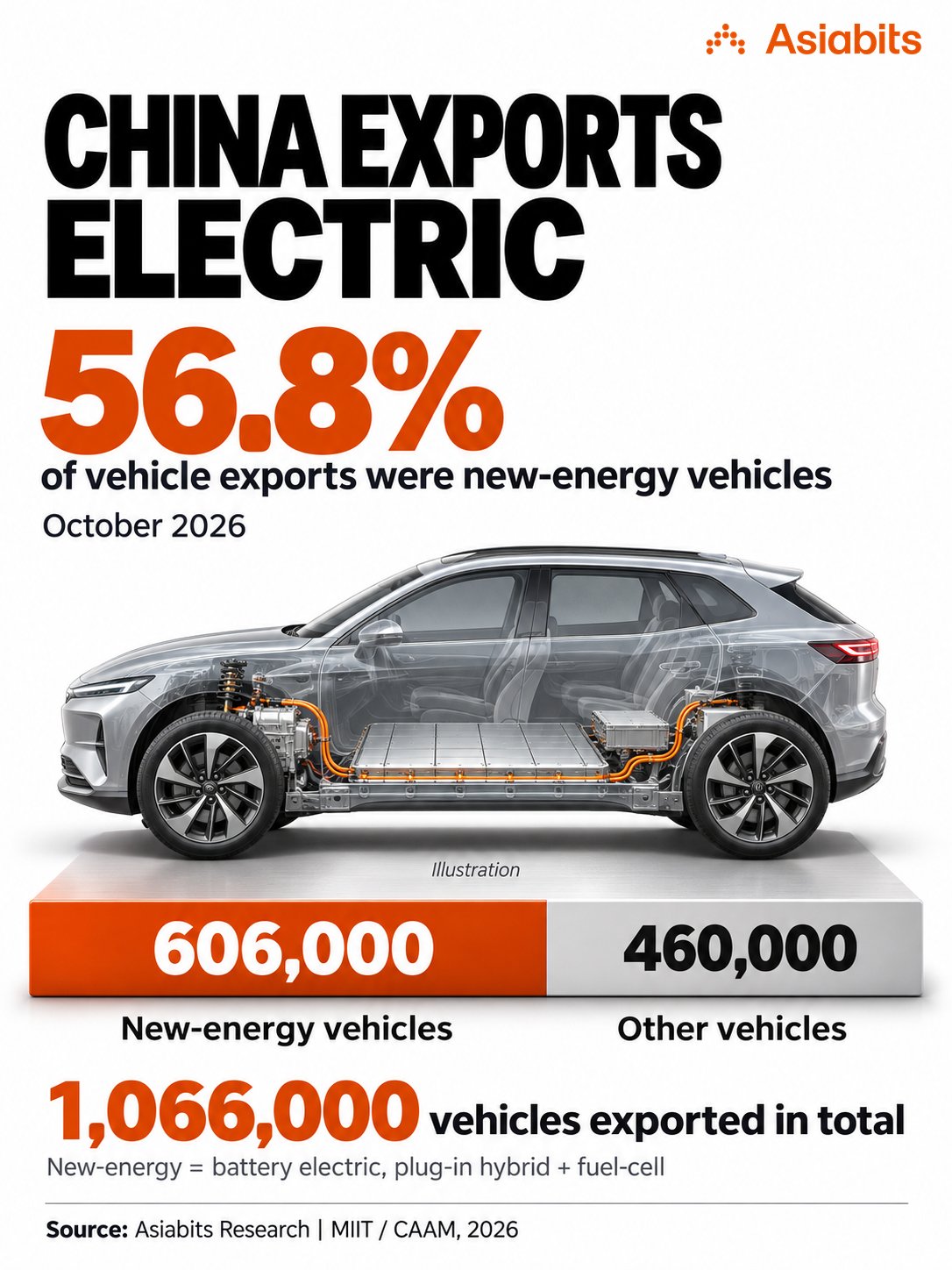
China exported 1.066 million vehicles in October 2026, including 606,000 new-energy vehicles. Dividing those figures gives a new-energy share of 56.8%. The remaining 460,000 vehicles are calculated by subtracting new-energy exports from the total.
October compared with the first ten months
The Ministry of Industry and Information Technology published the figures on 11 November, using China Association of Automobile Manufacturers data. Total October vehicle exports grew 60.2% from a year earlier. New-energy exports increased by around 140%, substantially faster than the overall category.
| China vehicle exports | October 2026 | January–October 2026 |
|---|---|---|
| All vehicles | 1,066,000 | 9,271,000 |
| New-energy vehicles | 606,000 | 4,612,000 |
| Other vehicles, calculated | 460,000 | 4,659,000 |
| New-energy share, calculated | 56.8% | 49.7% |
Across the first ten months, total exports rose 65.1%, while new-energy exports grew around 130%. The October share was about 7.1 percentage points above the January–October average.
What counts as a new-energy vehicle?
The category includes battery electric, plug-in hybrid and fuel-cell vehicles. It should not be read as a count of fully battery electric cars alone. The export totals cover vehicles, including commercial vehicles, rather than passenger cars only. The graphic’s generic cutaway vehicle illustrates an electrified powertrain.
Why the export mix matters
Asiabits’ interpretation: the mix is useful for suppliers assessing China-linked demand for batteries, power electronics and associated services. It also gives importers a more informative starting point than the total export count alone. Destination markets and the split between battery electric vehicles and plug-in hybrids would be needed to assess charging demand in a particular country.
Read the original MIIT October 2026 automotive release, based on CAAM data.
Get These Insights Every Monday
Join 18,000+ professionals reading Asiabits. Free, every Monday, straight from Shanghai.
Subscribe Free →