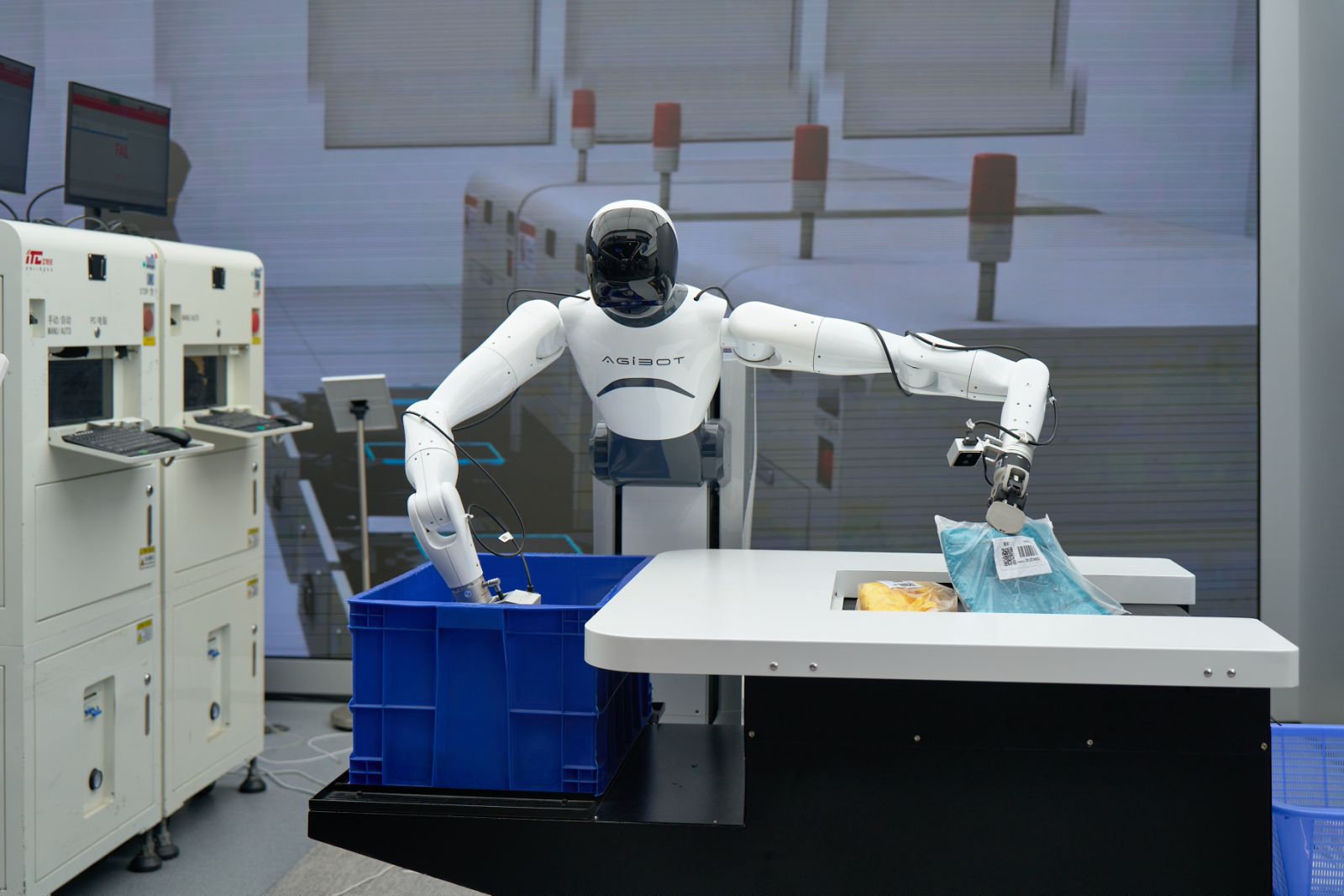
A report of four human interventions in an eight-hour robot shift sounds like a useful comparison. It becomes useful only when the report also says how much work the robot attempted, how much human help it needed and what output passed inspection.
For an automation team evaluating a robot pilot, including a humanoid system from a Chinese supplier, an intervention rate is a question about the job being measured. Keep the event definition, time window and task conditions alongside the number.
Define the event before calculating the rate
For the example below, one intervention is one continuous episode in which an operator helps the robot complete or recover the job. Several commands during that episode still count as one event. Fully automatic retries do not count as human interventions; record them separately.
An attempt starts when the robot begins one new pick-and-place job. Retries within that job remain part of the same attempt. An accepted completion means the correct part reaches the specified destination and passes the agreed placement check. Accepted output includes jobs completed with human help.
Two hypothetical shifts, one headline rate
These are invented teaching examples, not measurements of a manufacturer or customer. Both configurations perform the same defined job under the same task conditions for eight elapsed hours. That clock includes recovery and waiting. There is one assisting operator, and recovery episodes do not overlap.
Active assistance is the operator’s hands-on time, measured in person-minutes. Elapsed recovery runs from the interruption until the job can resume, including assistance and waiting. The assistance time is already inside recovery time; do not add the two.
| Recorded input | Shift A | Shift B |
|---|---|---|
| Elapsed observation time | 8 hours | 8 hours |
| New jobs attempted | 240 | 120 |
| Accepted completions, including assisted | 228 | 114 |
| Human intervention events | 4 | 4 |
| Active operator assistance | 8 person-minutes | 80 person-minutes |
| Total elapsed recovery | 20 minutes | 100 minutes |
Download the two example shifts as CSV to reproduce the calculations.
Read the four calculations together
- Events per elapsed hour: 4 ÷ 8 = 0.5 in both shifts.
- Events per 100 attempts: A is 4 ÷ 240 × 100 = 1.67; B is 4 ÷ 120 × 100 = 3.33.
- Active help per intervention: A is 8 ÷ 4 = 2 person-minutes; B is 80 ÷ 4 = 20 person-minutes.
- Accepted output per elapsed hour: A is 228 ÷ 8 = 28.5 jobs; B is 114 ÷ 8 = 14.25 jobs.
The headline frequency is identical, but B uses ten times as much active assistance and delivers half as much accepted output in the same observation window. This illustrates why event frequency alone cannot describe operating burden.
Four events spread across eight hours also do not establish two hours of uninterrupted autonomy: the events could cluster. An autonomous completion rate needs a separate count of jobs completed without human help. It cannot be recovered from this table.
Check that a recovery restores the physical job
A cleared software error and an accepted placement are different observations. For a pick-and-place pilot, agree who verifies the part’s identity, destination and placement after recovery, and how that check is recorded. A retry that leaves the part in the wrong position remains an unaccepted job.
Keep the failure cause and recovery outcome in the log. Repeated failures of the same type deserve separate review even when the overall event rate falls. Safety acceptance and restart decisions belong to the system’s risk assessment and responsible engineering team.
Ask what changed with the rate
Primary research supports treating a single intervention figure cautiously. In the Georgian and NewtonX Physical AI Survey, fielded from 24 July to 21 August 2026, 42% of the 85 surveyed buyers said they consistently tracked intervention rate. Only 20% said they could reliably measure whether a change had helped. These figures describe that survey sample.
Investment firm Georgian’s published analysis also describes buyers narrowing task conditions, routing harder cases to people or slowing the system while intervention fell. Ask whether the task mix, speed, quality checks, operator role or observation window changed between runs.
A useful request to a supplier is: “For the same defined job and time window, show attempts, accepted output, human-help episodes, active assistance minutes and elapsed recovery, including the cases that did not recover.” Agree those definitions before the pilot so both sides can reproduce the comparison.
Get These Insights Every Monday
Join 18,000+ professionals reading Asiabits. Free, every Monday, straight from Shanghai.
Subscribe Free →